
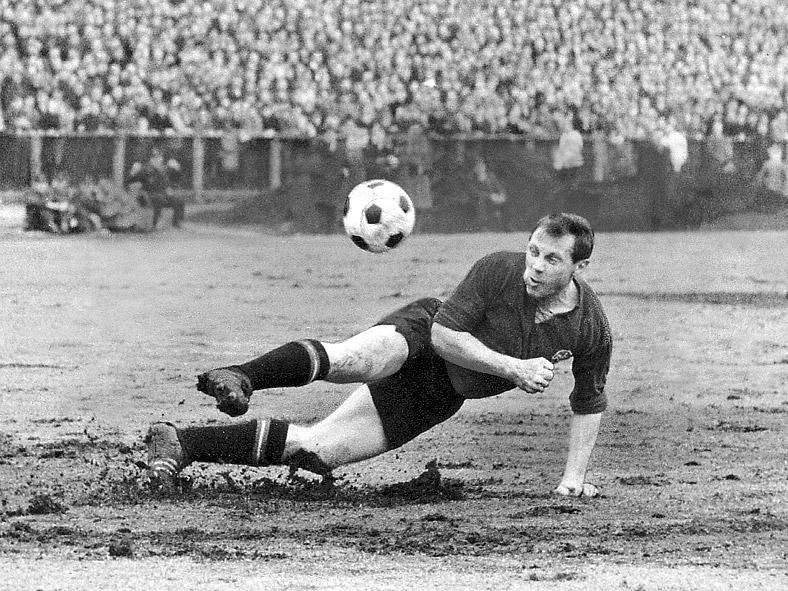

The 1954 FIFA World Cup in Switzerland remains the only world cup that saw a goals per game average of more than 5. It is also notable for an unnecessarily overcomplicated format that had conventional groups of four, but teams didn’t play in a round-robin manner. Rather each group was composed of two unseeded teams and two seeded teams.
To decide each group, four matches where seeded and unseeded teams faced each other were arranged. Moreover the group matches went into extra-times if the scores were tied at the end of 90 minutes and were adjudged to be drawn only if the scores were level after 120 minutes. The top two teams from each group would then go on to play quarter-finals. Such complications notwithstanding it was a very entertaining tournament which was certainly good news especially because it was the first world cup with television coverage.
In this series, which will run through all twenty two FIFA World Cup tournaments, we will try to tell the story of a player who had some important role to play in the tournament but hardly features among the first few names that jump out once you hear the tournament being mentioned. Today, in the fifth iteration of the series, we will look at West Germany’s Max Morlock.
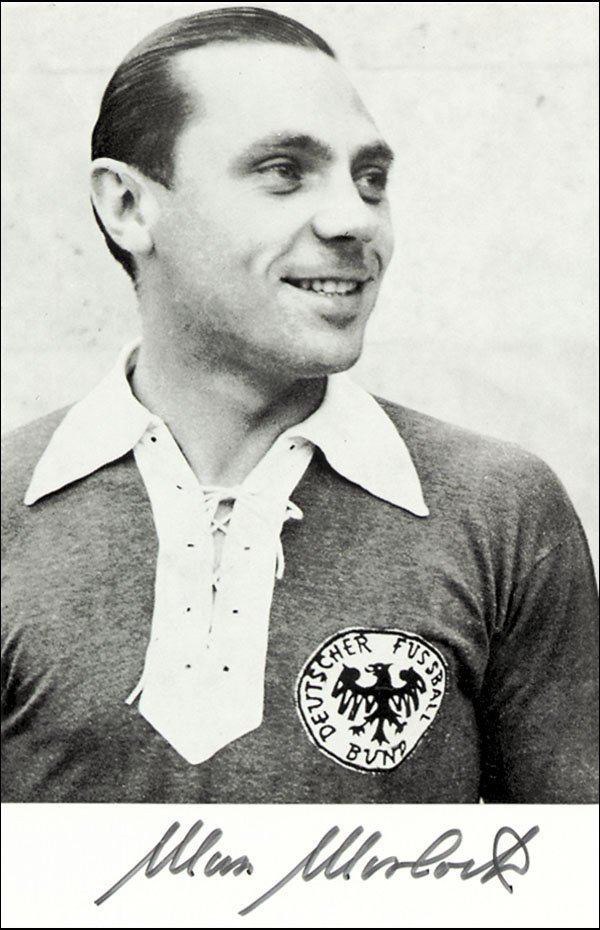
Max Morlock is a bonafide legend of FC Nuremberg for whom he played the entirety of his nearly quarter of a century long senior club career. A talented inside right known for his box-to-box ground coverage and sharp eye for goal, Morlock is the only German player to have played top-flight football in Nazi era Gauliga, post-war Oberliga and finally Bundesliga. He was an indispensable part of the victorious West German side in 1954 FIFA World Cup as his team’s top-scorer in the tournament. But his contributions often go under-discussed while his teammates like Fritz Walter and Ruhn are much more talked-about, alongside a number of stars from the Hungarian golden generation including Puskas, Hidegkuti and Kubala.
The unseeded and mostly unfancied West German side faced off against a weak but seeded Turkey side in their opening group match, easily winning the contest 4-1. Turkey had taken the lead within the first couple of minutes but Germany soon equalised with Morlock’s defense splitting pass expertly finished by Schafer. The first half ended 1-1, but it was West Germany that kept creating chance after chance, with Morlock at the heart of their attack, complementing the inside left Fritz Walter, the captain. In a commanding second half display he scored the last goal of the match by outwitting his marker and reaching the end of a long pass. His shot went in off the bar.
Against the outright favourites Hungary who had flattened South Korea 9-0 in their opening game, West Germany deployed a weakened eleven in order to keep their players fresh, knowing that even if they lose they would be going through if they win the play-off match that would pit them against the winner of the game between Turkey and South Korea. Morlock was rested as West Germany were soundly beaten 8-3 by the overwhelming Hungarian might.
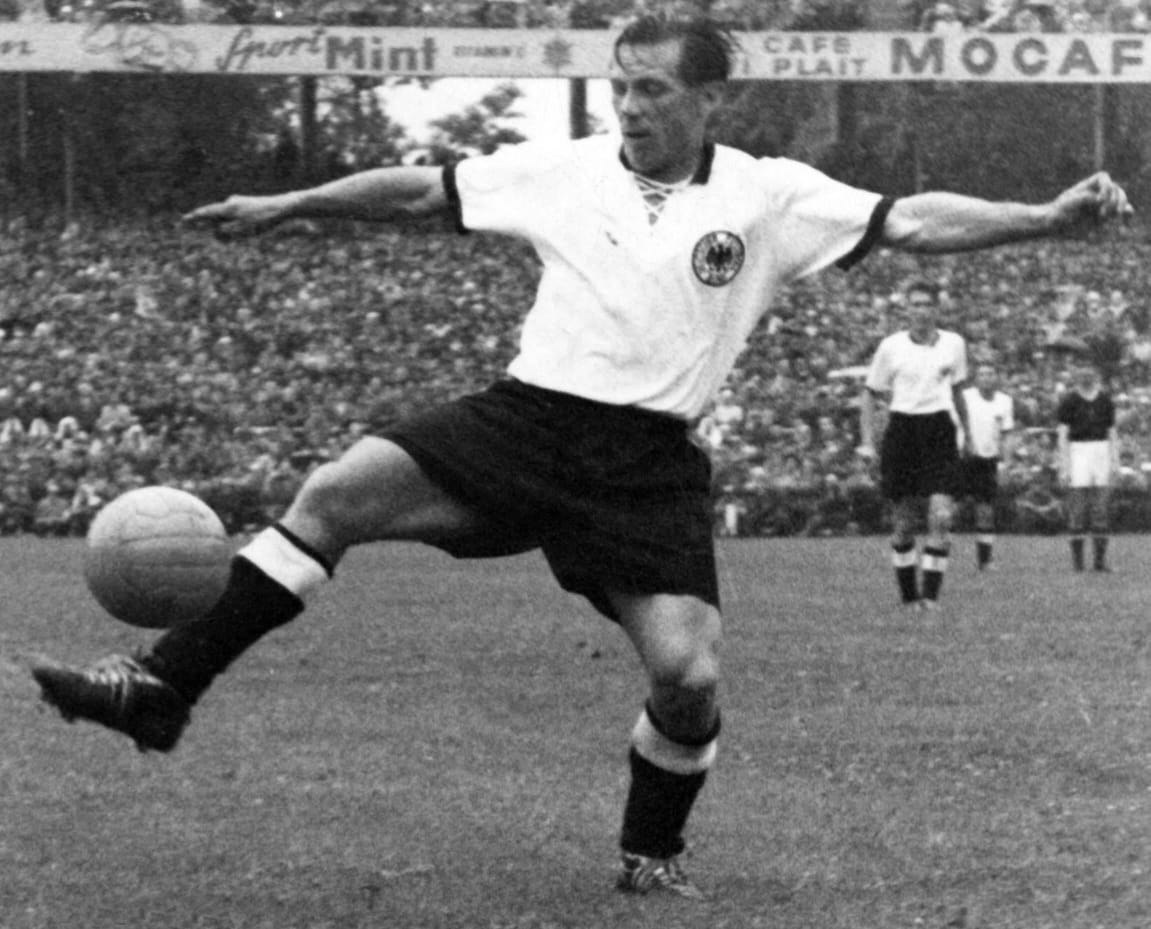
The play-off saw Germany playing Turkey just six days after their first meeting. Morlock came back into the side. In a very one-sided affair, Germany were cruising from early on. Morlock scored his side’s third goal around the half-hour mark, somehow being able to provide the decisive touch to a looping ball inside the box as he was being closed down by two defenders and an onrushing goalkeeper. He scored twice more in the second half – bundling one in from close range in the 60th minute and shooting another in from the edge of the box as he was provided enough time and space by a hapless Turkish defense in the 77th minute. Morlock’s hat-trick helped Germany to a 7-2 win that sent them to a quarter-final against a strong Yugoslavia side.
Germans were clearly the second favourites in their quarter-final clash but their organisation and industry shone through. Morlock contributed as much in attack as in defense as West Germany won a hard fought game 2-0.
The semifinal game against Austria looked like a game between past and present, with Austria playing in a slow and obsolete rhythm against a fitter and dynamic West Germany. Despite their reliance on pace and power, West Germany was creative enough to constantly produce goal-scoring opportunities. Morlock headed in a corner kick early in the second half for his fifth goal in the tournament. While most pre-game predictions had favoured Austria, West Germany easily won the game by a 6-1 margin.
The final saw West Germany face Hungary yet again. The greatest European player of the times, Puskas had returned to the supremely confident Hungarian side that missed its talisman during a hard-fought semifinal against Uruguay. Despite being more tired than their counterparts, Hungary raced into a 2-0 lead by the 8th minute.
West Germany was not completely pegged back though. In fact the first big chance of the game fell to Morlock whose header missed the target. Still, going two goals down against the outstanding favourites of the tournament had sapped the confidence of most German footballers. Fritz Walter later confessed that he was convinced that Hungarians were going to win at that moment. But it was the indomitable Morlock who walked up to his captain at this crucial juncture of the match and provided an inspirational call to action.
Soon after the restart, a Fritz Walter pass found Rahn in the left wing. Rahn’s low cross wasn’t properly cleared, leading to Morlock converting from close range to kick start the comeback. Ruhn scored twice as West Germany shocked everyone by winning the game 3-2, forever etching the occasion in the German post-war consciousness as the miracle of Bern. Morlock’s goal was complemented by his spirited and tireless contributions as an extra man in defense.
Fritz Walter was full of praise for Morlock. He maintained that Morlock was the man who kept the spirits up when the going got tough. He was someone who could, according to his captain, pull a cart out of sticky mud. In a tournament where Germany’s reputation of not giving up was being forged, Morlock embodied the courage and fortitude so cherished in German football.
Discover more from
Subscribe to get the latest posts sent to your email.