

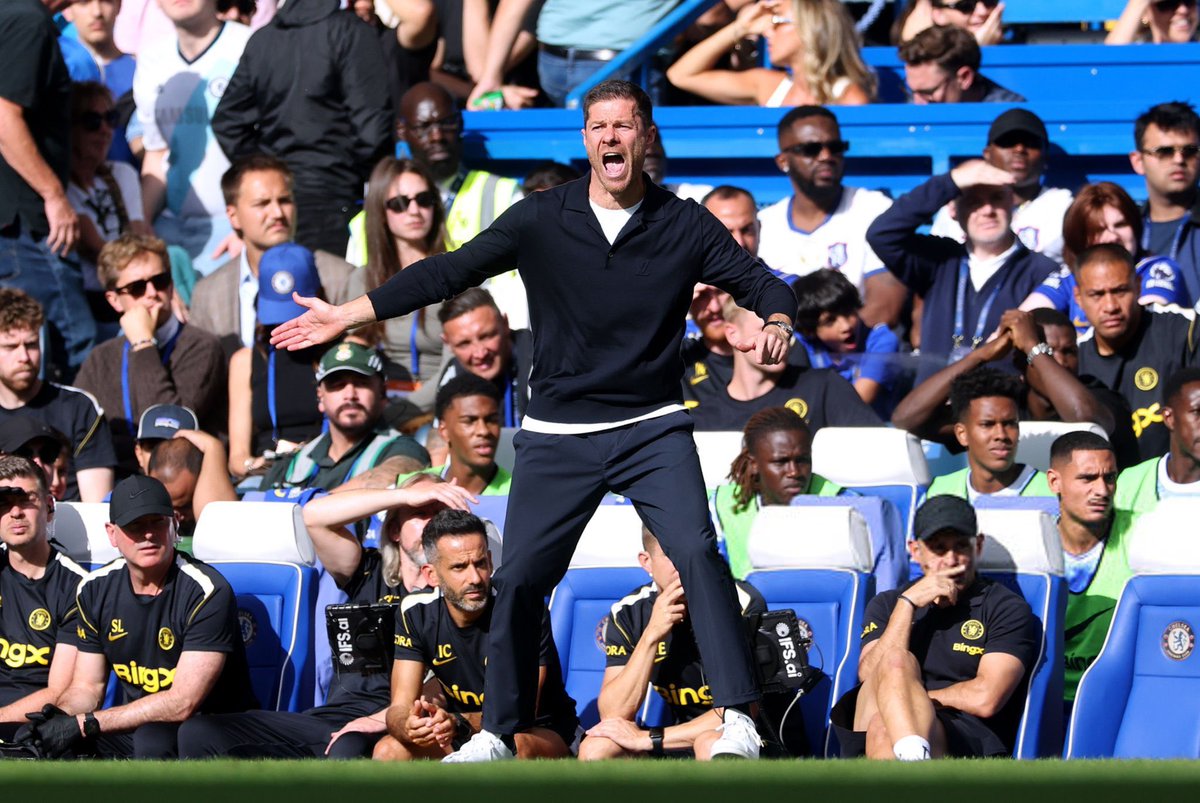

Xabi Alonso’s time at Chelsea marks a clear move away from the possession-based style that defined his title-winning campaign at Bayer Leverkusen. This change is not a step away from his footballing ideas, but a practical response to weaknesses in Chelsea’s midfield.
1. Strategic Context: The Tactical Shift and the “Midfield Crisis”
The tactical shift was driven by what can be described as a “Midfield Crisis”. Chelsea lost £125 million in Enzo Fernández and then failed to bring in a high-volume “Midfield Controller”. Because of this, Alonso has built a system around transition play and quick counter-attacks rather than waiting patiently for controlled buildup. Chelsea are willing to give up possession in order to create more dangerous and direct attacks.
Philosophy vs Pragmatism
The difference between Alonso’s Bayer Leverkusen and his first phase at Chelsea is clear.
At Leverkusen, Alonso’s team preferred to keep the ball, build up patiently and control matches through possession. They used short, controlled passes and a high defensive line to win the ball back quickly.
At Chelsea, the approach is more direct and practical. Chelsea have much less possession and often sit near the bottom of the league for possession share. Instead of always building up through midfield, they often use long passes to move the ball forward quickly.
The midfield also has a different role. At Leverkusen, the midfielders controlled the tempo of the game, deciding when to slow things down and when to increase the speed. At Chelsea, the midfield is sometimes bypassed, with the team looking to get the ball to the forwards more directly.
Defensively, Leverkusen were comfortable pressing high up the pitch. Chelsea, meanwhile, focus more on staying organised in a mid-block and being ready to attack quickly after winning the ball.
2. Structural Foundation: Asymmetrical Back Three
After briefly experimenting with a back four in pre-season, Alonso has committed to an asymmetrical back three.
This structure is designed to help Chelsea win second balls. It keeps more players close together in central areas, helping them compete in physical duels and then move the ball forward quickly.
Defensive Players’ Roles In Build Up
Levi Colwill: Colwill acts as the main line-breaking passer. His passing volume is currently lower than that of elite players in the same role, but his ability to pass from the left side remains Chelsea’s most reliable tool for progressing the ball from deep.
Josh Acheampong: Acheampong operates as the mobile right centre-back . His athleticism allows Alonso to create a specific right-sided rotation. When he moves forward, it triggers changes higher up the pitch, especially around the wing-back position.
Malo Gusto / Reece James: Both are used in hybrid “progressor” roles. James, in particular, can drop into the backline or move centrally to play as a deeper midfielder. This helps cover for Chelsea’s lack of a world-class No. 6.
The Rotational Trigger
The system tries to recreate the Tapsoba–Frimpong dynamic seen at Leverkusen.
When Acheampong moves forward from centre-back, this becomes the tactical trigger for Pedro Neto to either move inside or run in behind the defensive line.
This rotation gives Chelsea an important advantage: even when they bypass midfield, they can still create numerical advantages in wide areas during transitions.
3. Progression Phase: The Long-Ball Engine
Chelsea being second-bottom in possession share is a deliberate part of the system.
Because of the “Midfield Crisis,” Alonso has chosen a high-risk, direct approach in which the long ball is one of the main ways Chelsea progress up the pitch.
Chelsea’s Direct Progression
1. Vertical Directives
Long passes from the goalkeeper, target physically strong players such as Morgan Rogers and João Pedro. The aim is to create second-ball situations.
2. Bypass Protocols
When Chelsea are under pressure, the centre-backs are instructed to bypass the pivot completely. This reduces the danger of losing the ball to a high press deep inside their own half.
3. Progression
Cole Palmer effectively acts as a substitute for a No. 6. He drops into deeper central areas and begins attacks from positions normally occupied by a deep lying midfielder.
Despite playing in a more advanced role on paper, Palmer ranks exceptionally high for line-breaking passes.
The result is a high-turnover style of football. Chelsea accept that they will lose possession more often because the priority is to create a large number of counter-attacking opportunities. In this system, losing the ball can actually be part of the plan because it creates the next transition.
4. Strategic Spotlight: Flexible Formation, Stable Principles
The match against Hull City gave a useful look at Alonso’s core principles.
Chelsea used a back four for the first time in the league, but the basic ideas did not change. Even with around 70% possession, most of Chelsea’s danger still came from transitions.
Malo Gusto pushed high in right wide areas which is normally occupied by Neto, while Reece James dropped between the centre-backs to help with progression in the first line.
This shows that Alonso’s Chelsea is defined more by player roles and movements than by a fixed formation.
The formation can change, but the main objective remains the same: isolate the No. 10s and give them opportunities to attack quickly on the break.
5. The Creative Core: The “Twin 10s”
The tactical heart of the system is the use of Morgan Rogers and Cole Palmer as the “Twin 10s.”
Their roles are built around creating danger rather than simply keeping possession. They are given the freedom to take risks and look for quick, vertical actions.
Morgan Rogers:
Rogers is physically unusual for an attacking midfielder. Although his pass completion rate is low, his ability to win duels and make runs beyond the striker makes him a key target in Chelsea’s direct progression system.
Cole Palmer:
Palmer’s development into a “deep-lying 10” is similar to Arda Güler’s role at Real Madrid. By dropping deeper, Palmer helps solve Chelsea’s lack of players who can progress the ball through central areas.

He effectively acts as the “No 6” of Chelsea’s transitions, starting attacks from deeper positions.
However, relying so heavily on the two 10s creates a rest-defence problem.
Because Rogers and Palmer are more focused on attacking and keeping the ball moving forward than on defensive work, Chelsea can become exposed when the final pass fails. The team can then be forced to retreat quickly into a mid-block, making it harder to maintain pressure in the opposition half.
6. Defensive Phase: Pressing Volatility and the Wide-Cover Problem
Chelsea’s defensive phase remains the most unstable part of Alonso’s project.
The “broken press” seen during his Madrid spell is still visible and has led to three different defensive approaches:
1. Aggressive High Press
João Pedro leads the press from the front. The problem is that the pivot can become exposed when one of the 10s is pulled away from his position.
2. Targeted Centre-Back Press
The 10s are asked to press the opposition centre-backs. This can leave large spaces in wide areas and put heavy pressure on the wing-backs.
3. The 5–3–2 Mid-Block
This is a more defensive, “park the bus-style” retreat that focuses on protecting the centre of the pitch.
The Lateral Coverage Problem
The main issue comes from Rogers and Palmer having to protect the centre before moving out to cover the flanks.
This creates a heavy physical workload. As a result, their recovery runs can sometimes become slower, leaving the wing-backs isolated and allowing opponents to create a high number of crossing opportunities.
However, this positioning also has an important benefit.
By keeping the two 10s relatively high during the mid-block, Chelsea have attacking players already positioned to launch a counter-attack immediately after winning the ball.
So, the same positioning that creates a defensive weakness can also become a major attacking strength.
7. Final Output and Recruitment Priorities
Chelsea’s current statistical profile tells a clear story: they are overperforming their xG, leading the league in counter-attacking volume, and operating with very little possession.
This describes a team that can be extremely dangerous but also structurally unstable.
The trend of scoring an early goal — within the first 10 minutes against Fulham, Brighton, Arsenal and Hull — has helped hide some of the defensive weaknesses. Once Chelsea take the lead, they can sit deeper and make better use of transition situations.
Conclusion
The “Alonso Evolution” at Chelsea shows how a coach can adapt his tactics to the players available to him. In modern football this iscalled with the term “RELATIONISM”.
But for Chelsea to move from a transition-based team to a genuine title contender, recruitment must needed to address the missing Midfield Controller.
The current “Midfield Crisis” calls for a profile similar to Granit Xhaka: a high-volume passer who can break lines, control the tempo and help Chelsea regain sustained control of territory.
Until that type of player is added, Chelsea will remain a high-ceiling, transition-dependent team — extremely dangerous when attacking space on the break, but still vulnerable to losing their structure.
Discover more from Footy Times
Subscribe to get the latest posts sent to your email.
It’s a brief analysis about the Playstyle of Chelsea and Xabi Alonso.
Great .