

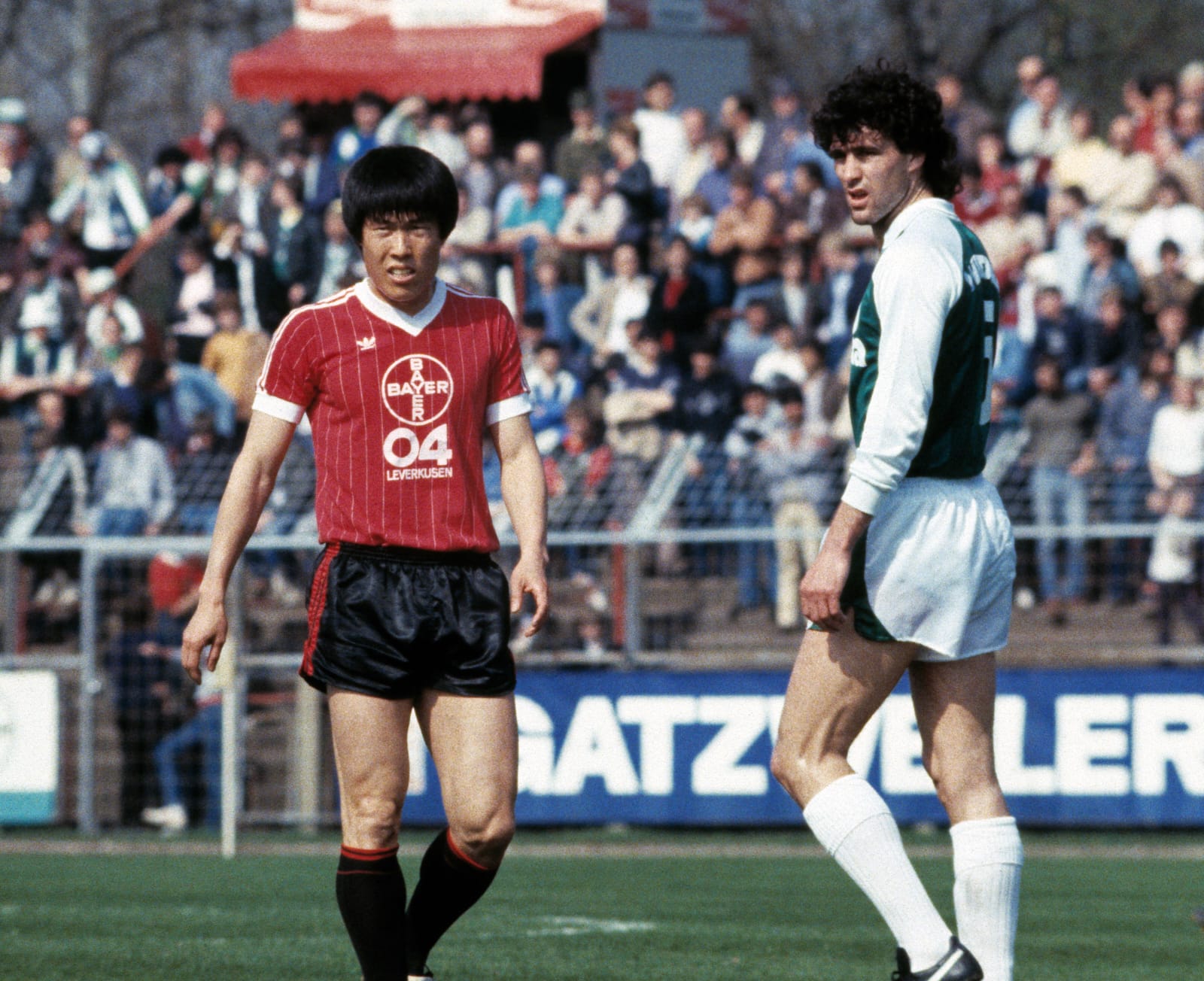
Leverkusen, where Son would also join three decades after Cha’s arrival, finished an unsatisfactory 11th in the 1982/83 season. Cha scored 12 times in the league in 1983/84, including a brace against Düsseldorf, important goals against FC Köln and Nürnberg, and a goal in his return to Frankfurt’s Waldstadion. Bayer’s form remained somewhat patchy, and they conceded as many as they scored. In Cha and Herbert Waas, Bayer had a dependable goal-scoring battery, but they only won 3 away games all season.
The next season was worse. They only won nine games, as many as the lowest-placed Eintracht Braunschweig, and finished 13th. Cha opened the season with an 85th-minute winner against Dusseldorf, but he and his team couldn’t build any winning momentum. Cha scored 10 league goals, but he had a much better return in DFB-Pokal, where Leverkusen were knocked out against Bayern Munich in the quarter-finals. After leading 2-0 at halftime, it was Cha’s fourth cup goal of the season that reduced the deficit against Bayern in the cup quarter-final, but it failed to inspire a comeback.
Hopes were not particularly high in Leverkusen on the eve of the 1985/86 season. Cha was already 32. Despite his commendable scoring record, there were a few concerns about whether his best days were past him. Cha didn’t start the season in blistering form. His first league goal came in the fifth game, and he had managed only 2 goals before October. But he scored an 87th-minute winner in a five-goal thriller against Kaiserslautern and followed it up with goals in Hamburg and Dortmund in the next two games. He ended the season with a personal best Bundesliga goal tally with 17 goals and scored twice in the DFB-Pokal. This was his highest goal-scoring season outside Korea. He reclaimed his place in Kicker’s Bundesliga team of the season. The club finished 6th, securing the UEFA Cup qualification for the very first time.
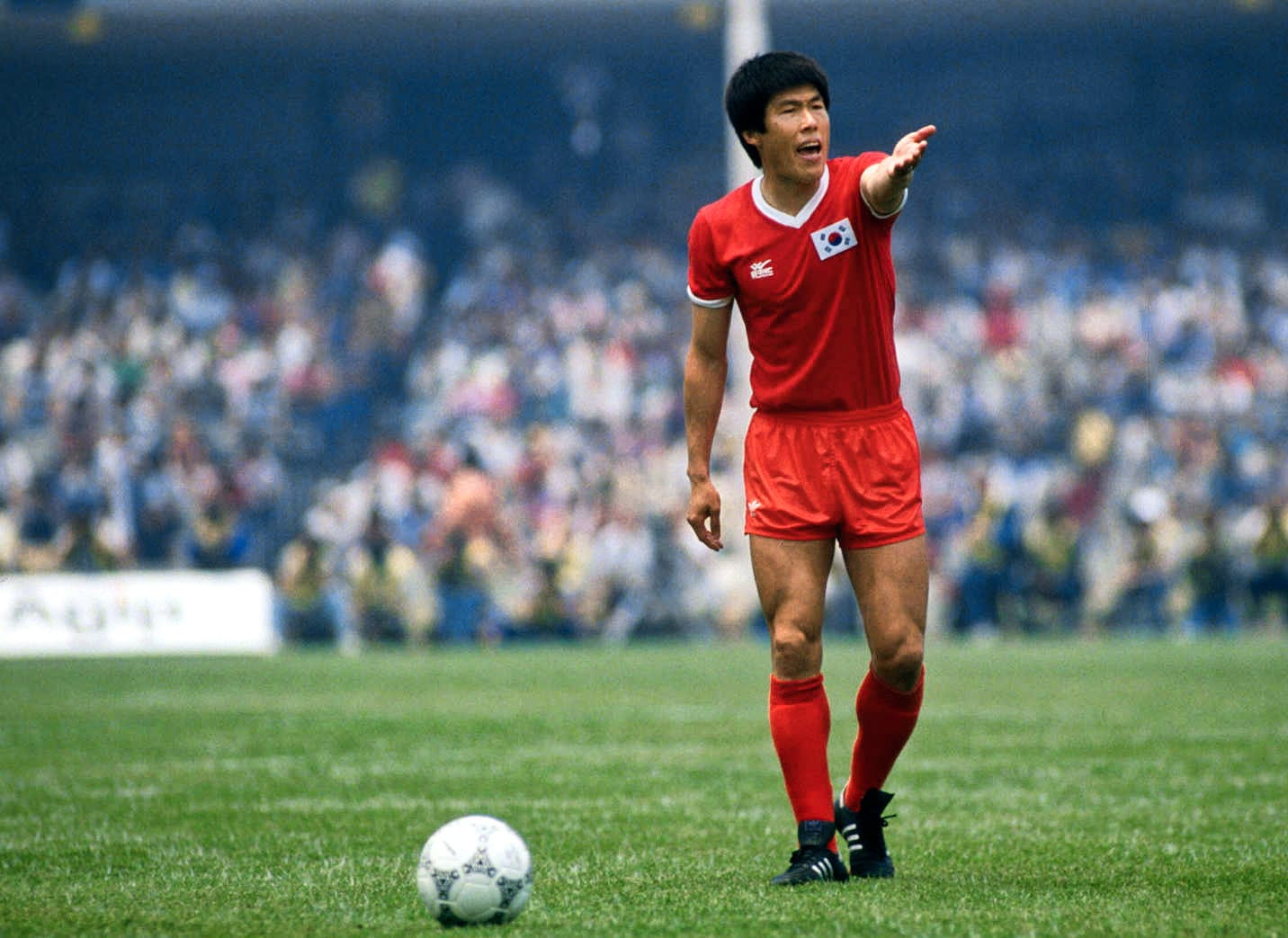
South Korea, meanwhile, had booked a berth at the 1986 FIFA World Cup. Cha declared his availability for the national team, emerging from an almost eight-year-long sabbatical to play for South Korea in their first World Cup in 32 years. They were drawn in a very tough World Cup group alongside eventual champions Argentina and reigning champions Italy. They were squarely beaten by Argentina in their opening match. A 1-1 draw against Bulgaria meant they had to beat Italy to qualify for the knock-outs. It was always a daunting prospect, and while South Korea equalised at 1-1 after the 62nd minute, Italy scored twice to effectively end the game by the 82nd minute. Cha Bum-kun played every minute of South Korea’s three World Cup matches, but couldn’t score a goal. While Cha ended his career with a more decorated club career, on the biggest stage of all, unlike his predecessor, Son successfully powered his country to qualification in the knockouts with an eye-catching display against a European powerhouse in a must-win final group game at a World Cup.
While Cha’s work-rate and intensity remained similarly notable, his scoring prowess waned. He scored only 6 times in 33 Bundesliga matches in the 1986/87 season. His return to the UEFA Cup, too, did not last long. Though he scored twice in three games, Leverkusen were unceremoniously knocked out by Dukla Prague in the second round. He was still his side’s third-highest scorer in all competitions in the 1986/87 season. Leverkusen held on to their last season’s standards and secured a 6th place finish, and with that, a return to the UEFA Cup again.
In the next season, Cha, then 34, scored only four times in the league, which was enough to make him the top-scoring foreign player in Bundesliga history to that point. He held this record for 11 years. Cha still features among the top ten foreign players in the all-time Bundesliga goal-scoring charts. Leverkusen slipped to 8th in the league and exited the domestic cup in the first round, but they were making the most of their second crack at the UEFA Cup. Cha scored his team’s last goal in the 5-1 second leg win over Austria Vienna in the opening round. This was one of his two UEFA Cup goals in the tournament. The other one would be much more decisive.
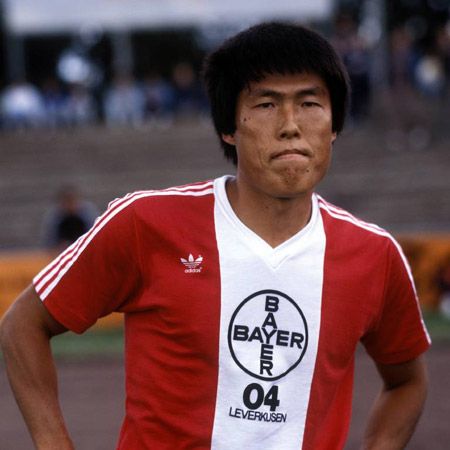
With three consecutive narrow wins over Feyenoord, Barcelona and Bremen in the round of 16, quarter-finals, and semifinals, Leverkusen faced Espanyol in the final. The first leg, played in Spain, saw Leverkusen suffer a humbling 3-0 defeat. Their prospects looked grim. In their last six UEFA Cup matches combined, they had scored a total of three goals. Now they had to do that within a stretch of 90 minutes without conceding. Despite the race against time, Leverkusen couldn’t breach Espanyol’s defence in the first half of the second leg. But they kept pushing, and a scrappy 57th-minute finish from Tita gave them a lifeline.
Six minutes later, through a brilliant diving header from Falko Gotz, it was 3-2 on aggregate, with Leverkusen hoping for a comeback for the ages to overturn what seemed an insurmountable lead. With less than ten minutes remaining, a cross came from a free-kick on the right side of the box. Within the crowded box, up rose Cha Bum-kun to bury an unstoppable header into the net. The home crowd went ecstatic. Cha’s last-ever UEFA Cup goal had restored the balance in the final. Espanyol could not master a response. The extra time ended goalless. Despite failing to convert their first penalty, the German side won the shoot-out to claim their first major club trophy. Days before his 35th birthday, Cha reminded everyone that class, indeed, is permanent.
Cha’s next season was his last in a glittering career. He scored only thrice in the league, including an 82nd-minute winner against Karlsruher SC. His last Bundesliga goal was little more than a consolation against Dortmund in a 2-1 loss. Cha hung up his boots after the season, after scoring 121 goals at a rate of about once in three matches in all competitions in Germany. Despite playing all but three of his international matches before turning 26, he remains the country’s top international goal-getter.
Cha always enjoyed great appreciation from colleagues and managers. He still enjoys cult hero status among the Eintracht and Leverkusen fan bases. Greats like Pele and Maldini were full of praise for Cha. Luis Figo once noted that growing up, He had been a big fan of Cha. Oliver Kahn admitted that in his youth, he always wanted to have Cha’s autograph. Jürgen Klinsmann maintained that he could never match Cha’s level on the football pitch. When the Midfield Maestro Michael Ballack travelled to South Korea to play the 2002 World Cup, he announced that he always wanted to visit South Korea because Cha was his idol.
Discover more from
Subscribe to get the latest posts sent to your email.