

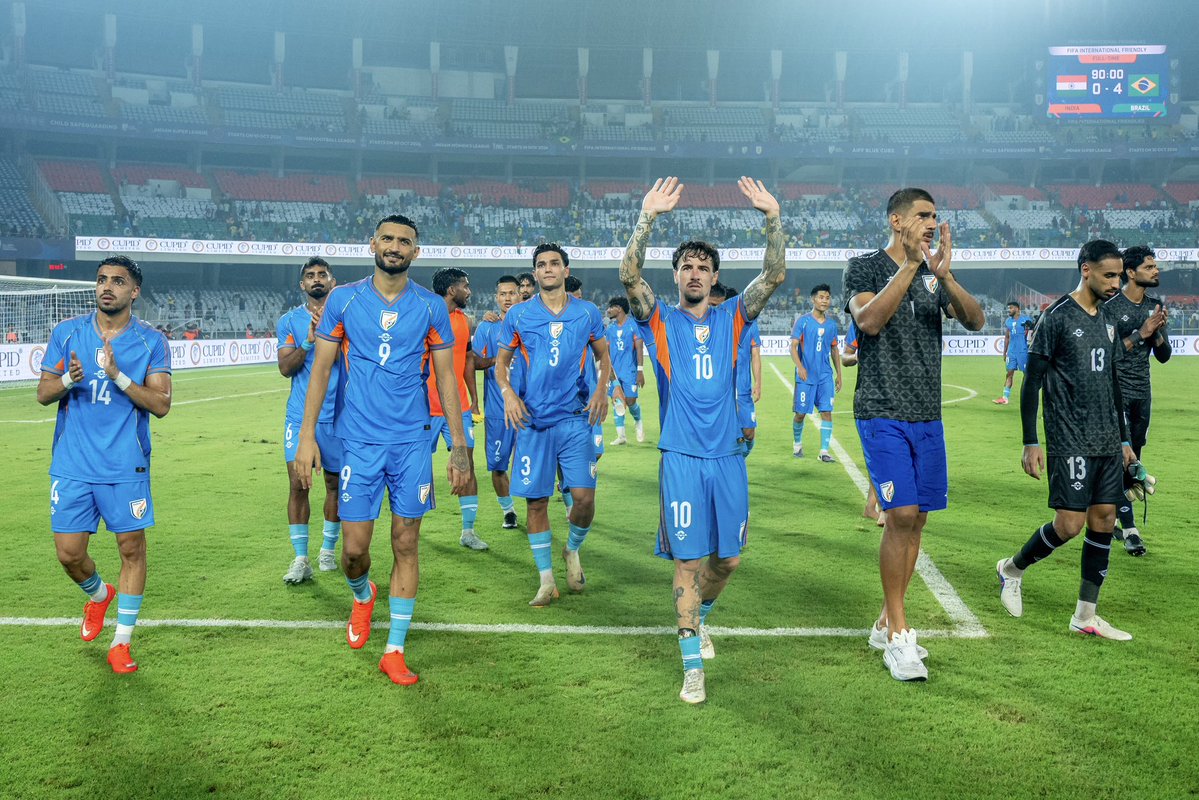

Carlo Ancelotti praised India after Brazil’s 4-0 win in Kolkata, saying they had played “their part well”. India had stayed with the five-time champions for much of the first half-hour. Khalid Jamil refused to be flattered. Asked to rate the performance out of ten, India’s coach gave a cryptic reply, “I have got zero points”, and moved on to the next question.
The two reactions mark the gap Indian football lives in. From the stands, a side that holds a five-time champion for half an hour looks like progress. From the touchline, the same match is a list of avoidable errors. Jamil called two or three of the goals “soft”, the product of individual errors.
The future of Indian football turns on whether evenings like this compound. India has never lacked moments. Every era has produced them. What it has lacked is a calendar, a legal framework and a set of institutions that turn a good year into a better one.
Moments without momentum
The first great moment came before independence. On 29 July 1911, Mohun Bagan beat the East Yorkshire Regiment 2-1 in the IFA Shield final in Calcutta. They were the first all-Indian side to win the tournament, and they played barefoot. The result became a nationalist touchstone.
The golden age followed under Syed Abdul Rahim, who coached India from 1950 to 1963. India won Asian Games gold in New Delhi in 1951, beating Iran 1-0. They finished fourth at the 1956 Olympics, still their best result there. They won gold again in Jakarta in 1962, beating South Korea 2-1.
Yet the era’s defining decision was a withdrawal. India qualified for the 1950 World Cup by default, after Burma and the Philippines pulled out of their group. Then India withdrew themselves, ten days before the tournament, citing insufficient time, delayed information and selection differences.
The popular explanation, that FIFA banned barefoot play, is a myth. India played barefoot at the 1952 Olympics without objection. The real reason was priorities. The federation valued the Olympics more. The captain, Sailen Manna, later said India had “no idea” about the World Cup then. FIFA had reportedly offered to cover part of the travel costs.
The irony came at Helsinki in 1952. India lost 10-1 to Yugoslavia in the first round. The country’s best chance of reaching a World Cup was lost to an institutional misjudgement, not a shortage of talent.
Rahim’s death in 1963 closed the era. India still finished runners-up at the 1964 Asian Cup, their best result there. The next decades were quieter. India’s best-ever FIFA ranking, 94th, dates from February 1996, the year the first national league began.
That league has been rebuilt repeatedly. The National Football League started in 1996 and became the I-League in 2007. The Indian Super League launched in October 2013, backed by IMG-Reliance and Star Sports. For nearly a decade the two ran in parallel. The ISL became the sole top tier in 2022-23. The top division has been reinvented three times in thirty years, and each restart reset the clock.
The modern pattern repeats the old one on a smaller scale. India hosted the 2017 Under-17 World Cup, which drew a record 1,347,133 spectators. Eight years later the Under-17s missed the 2025 AFC Under-17 Asian Cup, losing 3-2 to Thailand in a must-win qualifier. They qualified for the 2026 edition, their 10th appearance. That volatility is the point: good years do not reliably build on each other.
In 2023, India briefly entered the FIFA top 100 after winning the Intercontinental Cup, the SAFF Championship and a Tri-Nation Series, IndiaSportsHub noted. Those were regional and invitational events, which let a team choose its tests. Qualifiers allow no such choice.
India finished third in their 2026 World Cup qualifying group, with five points from six matches. In the Asian Cup qualifiers, a 94th-minute goal at Hong Kong in June 2025 started the damage. Singapore ended India’s hopes that October with a 1-2 win in Goa. India finished fourth in a four-team group they were ranked highest in. Even after sliding to 136th, they sat well clear of Singapore (155th) and Bangladesh (183rd).
The ranking path tells the story. India fell to 133rd in July 2025, their lowest in nine years, and to 142nd after losing in Bangladesh that November. They stand 138th now.
The women’s team shows the same shape. They topped their qualifying group and returned to the Women’s Asian Cup after 22 years, The Bridge reported. In Australia they lost 2-1 to Vietnam, 11-0 to Japan and 3-1 to Chinese Taipei. Reaching a stage is easier than surviving it. Survival needs depth, and depth comes from matches.
What would make it compound
Minutes come first. The ISL’s 2026-27 season starts on 10 October. As many as 13 clubs playing home and away means at most 24 league games each, within 163 matches including playoffs. A Premier League club plays 38. Last season’s ISL began in February in a truncated single-leg format.
The Brazil game hints at the cost. India had about a third of the ball, and Jamil’s “soft” goals included one that followed a loss of possession while playing out from the back. Errors under pressure are partly a repetition problem, and repetitions come from matches.
Rules can protect minutes only at the margin. ISL clubs may register six foreign players and field four, which leaves at least seven Indians on the pitch. In June, the AIFF floated a mandatory slot for an overseas Indian-origin player and an Indian striker for the full 90 minutes. It softened both in July and made them optional. Saudi Arabia’s league went the other way. It required only three Saudis on the pitch after raising its foreign quota, and Roberto Mancini complained that Saudi players were losing playing time. India’s rule protects starting places. It cannot create the matches in which to use them.
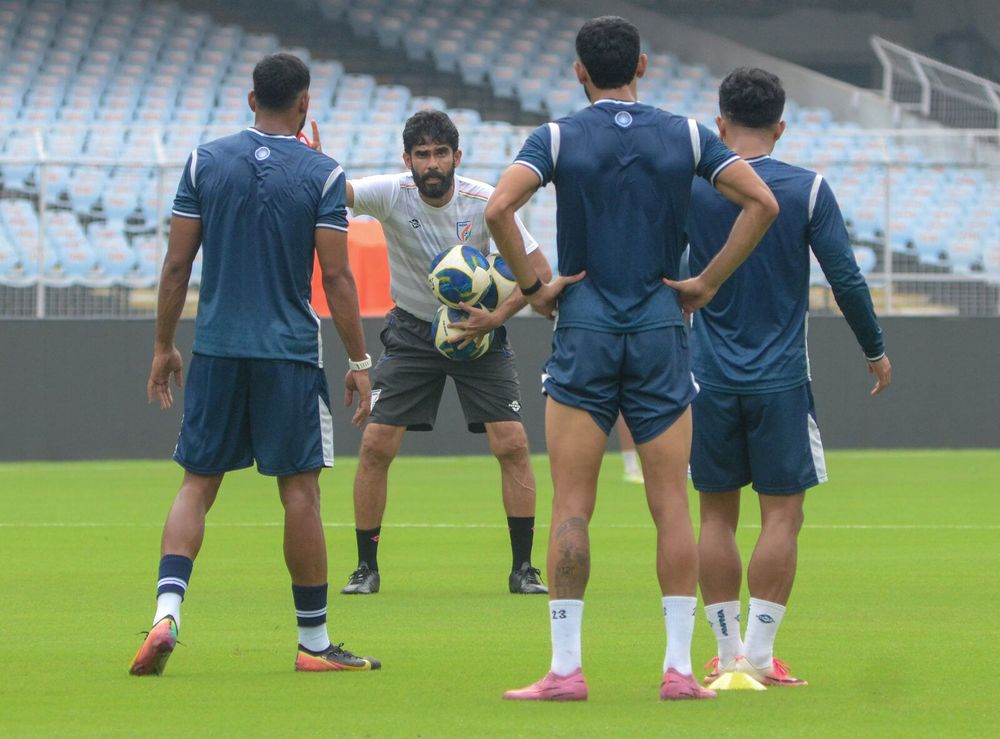
Access to talent is the second condition, and here India faces a legal barrier. Morocco fielded 19 foreign-born players in its 26-man World Cup squad, the New Indian Express reported. Its federation had lobbied FIFA to ease eligibility, Al Jazeera noted. India’s barrier is domestic law, not FIFA’s rulebook. India does not allow dual citizenship, and a 2008 sports ministry policy requires national representatives to be citizens. FIFA regulations require a player to hold the passport of the country he represents. Overseas players of Indian origin must therefore give up their foreign passports.
Ryan Williams did exactly that. Born in Perth, with a mother from an Anglo-Indian family in Mumbai, he renounced his Australian citizenship. He was only the second foreign-born player to take that route, after Arata Izumi in 2012. He scored in the Panama draw.
The AIFF has reportedly identified 24 to 28 more targets of Indian origin, the Shillong Times reported. From 2026-27, ISL clubs can sign OCI players, though they count within the foreign quota. A “Sports Passport” proposal, creating a special eligibility route, has reportedly reached the Prime Minister’s Office. Its final shape is undecided, and an AIFF official said any change depends on government policy. This is a legal question, and football cannot settle it alone.
Institutions are the third condition. India’s constitution case sat before the Supreme Court from 2017 until it approved a draft in September 2025. FIFA had already suspended the AIFF in 2022, and FIFA and the AFC warned of a second suspension over the delay. The AIFF’s agreement with the ISL’s commercial partner was due to expire in December 2025. A 2026 tender drew a Genius Sports bid of around Rs 2,129 crore over 15 years plus five. Clubs opposed it and took over the commercial side instead, initially proposed as a two-year pilot. Our explainer covers what the club-led model changes.
The dugout has been just as unsettled. Manolo Márquez left after that June 2025 defeat at Hong Kong. Jamil, the first Indian in the job since 2012, took over with no international coaching experience, Gulf News noted. Each fix was a rescue. None was a plan.
Morocco’s contrast is instructive. Its federation began with governance in 2008, then built mass-participation pitches and a national academy, Al Jazeera reported. Its Under-20 side won the 2025 World Cup. It appointed a new head coach less than 100 days before this World Cup, FIFA noted, and still reached the quarter-finals. The comparison has limits. Morocco’s project rested on royal patronage and state money that India cannot copy. The sequence is copyable: governance, then participation, then elite development, each given time.
Demand is the fourth condition, and history shows India has it. The 1997 Diamond Derby, East Bengal 4-1 Mohun Bagan, drew a record 131,781 to Salt Lake Stadium. The stadium held 120,000 until 2011. Its capacity is now 68,000. The Brazil match offered a clue about what has changed. PTI reported little of the frenzy that fills Salt Lake on derby days, when thousands queue outside.
Pricing played its part. Club-allocated tickets cost Rs 6,000, or Rs 5,400 after discount. The Indian Football Association received 24 requests for its 2,000 tickets, and the AIFF later cut Uruguay prices to a flat Rs 199.
Crowds that do come tend to come for local belonging. Super League Kerala’s biggest crowd of 2025 was 34,137, for Calicut against Malappuram. Spectacle borrows attention. Clubs rooted in a place keep it.
The SAFF Championship in November will give another regional data point, though regional trophies have flattered India before. The fuller test is the next qualifying cycle. Asia had eight direct World Cup places in 2026, and trackers project a similar number for 2030 if FIFA keeps 48 teams. India finished third in a four-team group with Qatar, Kuwait and Afghanistan. More places help only teams that finish in the top two of their groups.
The future of Indian football will be decided by dull things: a fuller calendar, a citizenship rule that fits the sport, a league whose finances survive a contract expiry, and clubs people turn up for. If those arrive, evenings like the Brazil match become milestones. If not, they stay moments.
Read more – Khalid Jamil’s India Fight Bravely Against Brazil Despite 4-0 Defeat in Historic Clash
Also see – Kerala Blasters Officially Announce Amrinder Singh and Mohammed Yasir Signings
Follow Footy Times on Social Media:
Facebook | Instagram | Twitter | YouTube
Discover more from Footy Times
Subscribe to get the latest posts sent to your email.