
On 17 June 2006, in Frankfurt, a 21-year-old wearing the number 17 shirt stepped up to take a penalty for Portugal against Iran. He was wearing 17 because Luis Figo — Portugal’s captain, their most decorated player, the man whose shoes he would one day fill so completely that the comparison would seem obvious in retrospect — had the number 7. The youngster was not yet the senior figure in that dressing room. He was not yet the one the cameras searched for first, or the one whose movement was tracked by the opposition’s defensive meetings. He was a Manchester United forward of extraordinary potential and considerable flair who had been growing into this stage slowly, carefully, not entirely comfortably.
He sent the Iranian goalkeeper the wrong way. The ball went in. Portugal won 2-0.
It was his first goal at a World Cup.
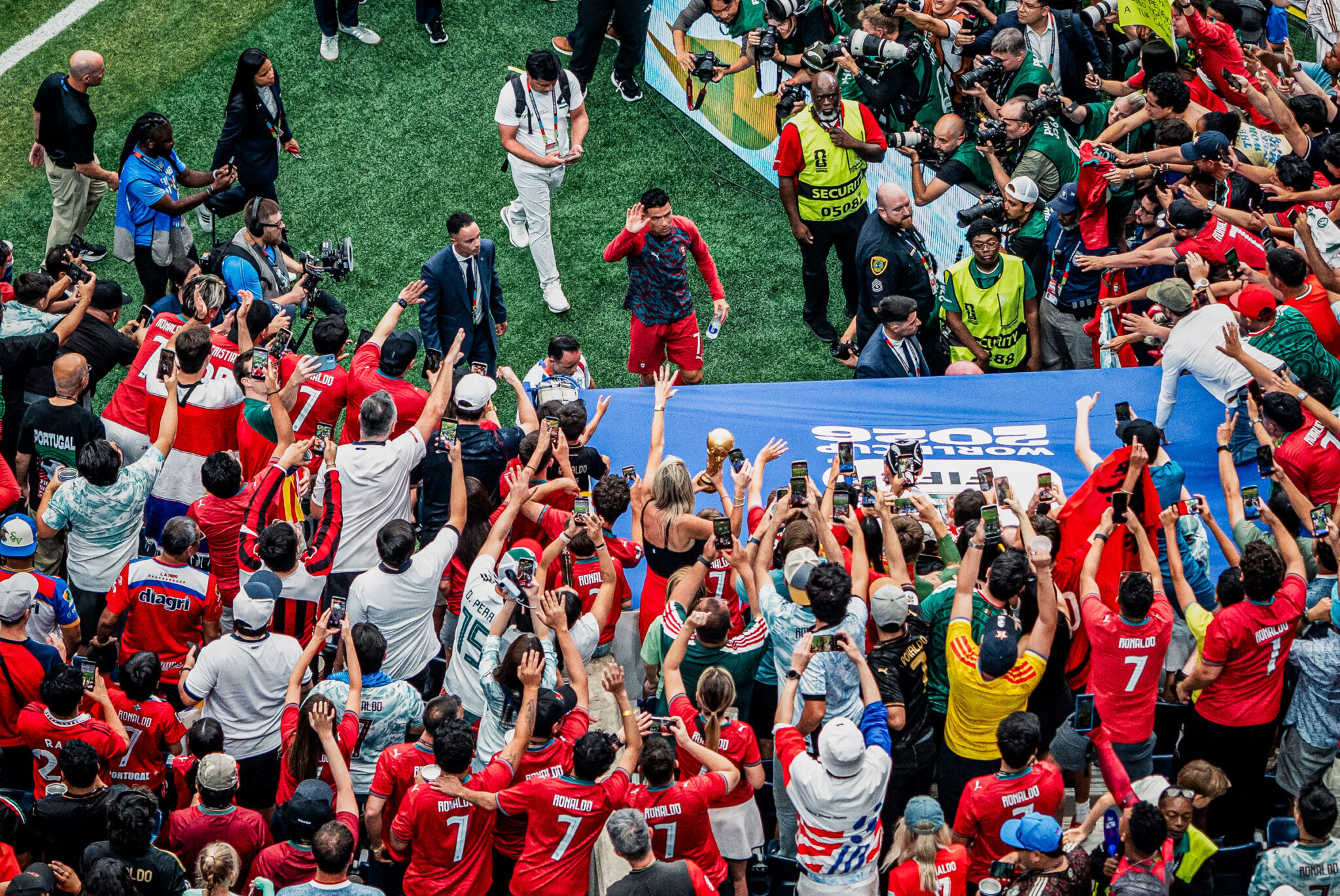
Yesterday afternoon at NRG Stadium in Houston, at 41 years and 138 days old, wearing the number 7, as captain, as the man who had long since made every comparison to Figo feel like a historical footnote, Cristiano Ronaldo scored twice against Uzbekistan. With the first of those goals, he became the first player in the history of football to score in six different editions of the FIFA World Cup. With the second, he passed Eusébio as Portugal’s all-time leading scorer at the tournament, reaching ten World Cup goals.
Twenty years between the first and the sixth. In the space between them: almost everything.
The World Cup has a habit of revealing people as they are rather than as they present themselves. The club game affords a kind of controlled revelation — the same city, the same tactical system, the same teammates absorbing the pressure from every direction — but the World Cup strips that back. Every four years, Ronaldo has stood before it as a different person, and the tournament has shown him accordingly.
The 2006 version, in Germany, was the prodigy — wearing 17, playing behind Figo and Pauleta and Deco, contributing to a fourth-place finish that felt at the time like the beginning of something. Portugal beat England in the quarter-finals, Ronaldo converting the winning penalty in the shootout. He was jeered in Stuttgart during the third-place match against the tournament hosts. Even then, at 21, he attracted the extremes — the devotion and the hostility — that have characterised every public relationship with him since.
By 2010, in South Africa, he arrived as the world’s most expensive player, a Ballon d’Or winner, Portugal’s captain. He scored one goal in four matches — a scrappy effort in a 7-0 rout of North Korea. Portugal went out in the last 16 to Spain. The criticism was comprehensive and he took it with a visible difficulty that he has never fully learned to conceal. The mask of composure on Ronaldo’s face, at the low moments, has always been a mask rather than a settled expression. You can see through it if you look.
In Brazil in 2014, he arrived nursing a knee injury, played every minute of Portugal’s three group matches regardless, and scored a late goal against Ghana that was not enough to keep them in the tournament. The image from that World Cup is not the goal. It is Ronaldo, in the second half of the Ghana match, running full-tilt at a defence as if the effort of his own body could reverse an arithmetic that was already settled. Portugal went home after the group stage. He kept running anyway.
Russia 2018 was the high-water mark of his World Cup career. Against Spain in the opening match, he scored three times — a penalty, a second goal, and a curling free-kick in the 88th minute that flew over the Spanish wall and secured a 3-3 draw. It was, and remains, one of the great individual performances in the tournament’s group stage history. He scored four goals in the tournament and was eliminated in the last 16. He finished with his country’s record for World Cup goals, a hat-trick against their Iberian neighbours, and a defeat by Uruguay that left him, at 33, wondering how many more chances would come.
Qatar 2022 gave him one more. He scored a penalty against Ghana to become the first man to score at five different World Cups. He cried when he was benched against Switzerland. He watched from the stand as Portugal dismantled the Swiss 6-1 without him. Morocco ended the campaign in the quarter-finals. In the dressing room afterwards, the camera found him and he was weeping. He had looked, for a painful few minutes, like a man who understood that the exit from a World Cup stadium is sometimes also an exit from one of the things that gave your life its shape.
He came back anyway. Of course he came back.
The context for yesterday requires a sentence of honest acknowledgement: the day before Portugal’s match against Uzbekistan, Lionel Messi scored a hat-trick against Algeria, equalled Miroslav Klose’s all-time World Cup scoring record of 16 goals, and received a standing ovation at Arrowhead Stadium in Kansas City. The parallel running of their careers through this tournament — both at their sixth World Cup, both still scoring, both still carrying their nations — has been one of the tournament’s recurring miracles. But June 23 was specifically charged by what June 22 had produced.
Portugal’s opener against DR Congo had been laboured and unconvincing, ending 1-1, with Ronaldo ineffective and swarmed by Congo’s defensive system throughout. The pressure from home was immediate and pointed. Former Portugal international António Simões said Ronaldo “doesn’t play to win, he plays to be the main figure.” Roberto Martínez deflected the question with characteristic composure. But the pressure was real, and the timing of Messi’s masterclass the night before made it realer still.
In the sixth minute against Uzbekistan, João Cancelo cut the ball back into the area. Ronaldo, arriving at the near post, slid a first-time right-footed finish past the goalkeeper. The record was his — first man in history to score at six different World Cups — before he had been on the pitch for ten minutes. He wheeled away, arms wide, the famous celebration unchanged in twenty years, the crowd in Houston giving back everything he had asked of it.
His second came in the 39th minute: a Bruno Fernandes through-ball, Ronaldo on the right side of the area, sliding it into the bottom-left corner. At 41 years and 138 days, he became the second-oldest scorer in World Cup history — behind only Roger Milla, who was 42 when he scored for Cameroon in 1994. He also became the oldest player to score a brace at the tournament. His ten World Cup goals now surpass Eusébio’s nine — all scored by the great Eusébio in a single tournament in 1966. That specific record — Portugal’s, the one that connects him to the lineage of the country that made him — carries a different weight from the universal ones.
Nuno Mendes added a stunning free-kick. An own goal extended the lead further. Rafael Leão, introduced as a substitute for Vitinha, smashed a fifth in the 87th minute. The 5-0 scoreline was comprehensive and somewhat beside the point by then. What mattered had been established in the sixth minute, and confirmed in the 39th, and will be remembered long after the result against Uzbekistan is filed as a footnote.
There is a record Messi cannot match him on. Messi did not score in 2010. Ronaldo scored in every World Cup he played. Six tournaments, six editions with a goal. A span of twenty years between the first and the sixth. The consistency of it across the decades is staggering not because of the quantity — ten goals is a fine total but Messi already has more — but because of the relentlessness. At every stage of a career that has taken him from Manchester United to Real Madrid to Juventus to Al-Nassr, in every physical and psychological condition the sport can produce, with every variation of pressure and expectation and criticism that global football can manufacture, he has found a way to score.
His 144 international goals remain the men’s record. His six World Cups are matched only by Messi. His scoring at six different editions is matched by nobody, and will not be matched for as long as the tournament continues in its current form — because the time between tournaments is four years, and no player who begins scoring at a World Cup at 21 will still be scoring at 41 unless they are, in some fundamental sense, built differently from everyone around them.
That difference is not merely physical, though the physical dimension is extraordinary. Roberto Martínez spoke before the tournament about what Ronaldo brings to training — the standards he demands of himself and others, the refusal to accept reduced intensity, the quiet coercion of example. The players around him are twenty years younger in some cases. They watch him work and understand, from the watching alone, that what he has achieved is not an accident of talent.
The question that remains — the one this tournament has not yet answered — is the one that has followed him through every World Cup since 2006. He has won the Euros, the Nations League, the Champions League, every domestic trophy his clubs competed for. The World Cup is the single major honour missing from a collection that would otherwise constitute the most complete haul in the sport’s history.
He is 41. This is his sixth and almost certainly his last. Portugal’s next match is against Colombia — a far sterner test than Uzbekistan. The knockout rounds, if they reach them, will be sterner still. The bracket, eventually, will produce an opponent that cannot be managed by individual brilliance alone, and that question about collective dependence on a 41-year-old will need answering with football rather than with words.
But yesterday, in the sixth minute, João Cancelo’s cut-back arrived at his feet and he slid it home, and the record was his, and the stadium sang, and the number 7 shirt — the one he had to wait for, the one that belonged to Figo when he was still the prodigy, the one he has now worn so long that the number seems to have been invented for him — was there on his back as it has always been, in every important moment, across twenty years and six tournaments and ten World Cup goals.
SIUUU.
Read more – World Cup favourites ranked (again) after the Second Round
Also see – Record Breaker, History Maker: There Is Simply Nobody Like Messi