


On June 16, 2006, an 18-year-old scored his first World Cup goal. On June 16, 2026, the same man scored three. This is what twenty years looks like.
There are players who belong to a generation. And then there is Messi, who belongs to all of them — the generation that watched him arrive, the generation that watched him suffer, the generation that watched him win, and now this one, watching him refuse to leave.
Twenty years ago today, an 18-year-old with long hair and a nervous energy he was not yet old enough to fully conceal came off the bench in the 74th minute of a World Cup match in Gelsenkirchen. Argentina were already 3-0 up against Serbia and Montenegro.
Nothing was at stake. Pékerman sent him on anyway, as if introducing a player to a stage that would eventually belong to him — as if the coach already knew, and wanted the world to begin knowing too.
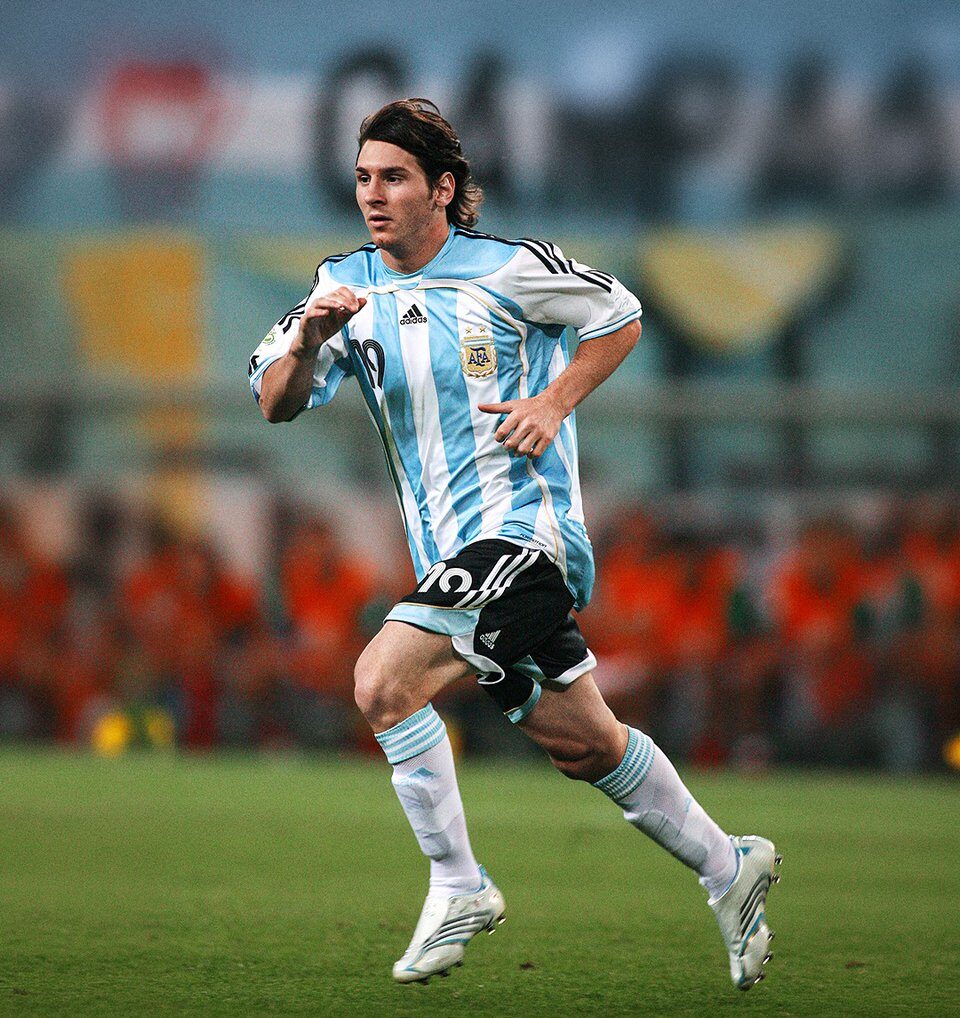
Diego Maradona was in the stands. The Argentine fans held a banner that read: “This Is My Dream.” Among the substitutes on that bench was Lionel Scaloni, watching as Messi received his final instructions. Scaloni was a peripheral figure at the end of his career, witnessing the beginning of someone else’s. Within four minutes, the teenager scurried into the box and squared for Crespo. Ten minutes later, Tevez slipped him in, and he scored. Argentina 6-0. His first World Cup goal. His first minute on the grandest stage of football history.
It was June 16, 2006. He was 18 years and 358 days old.
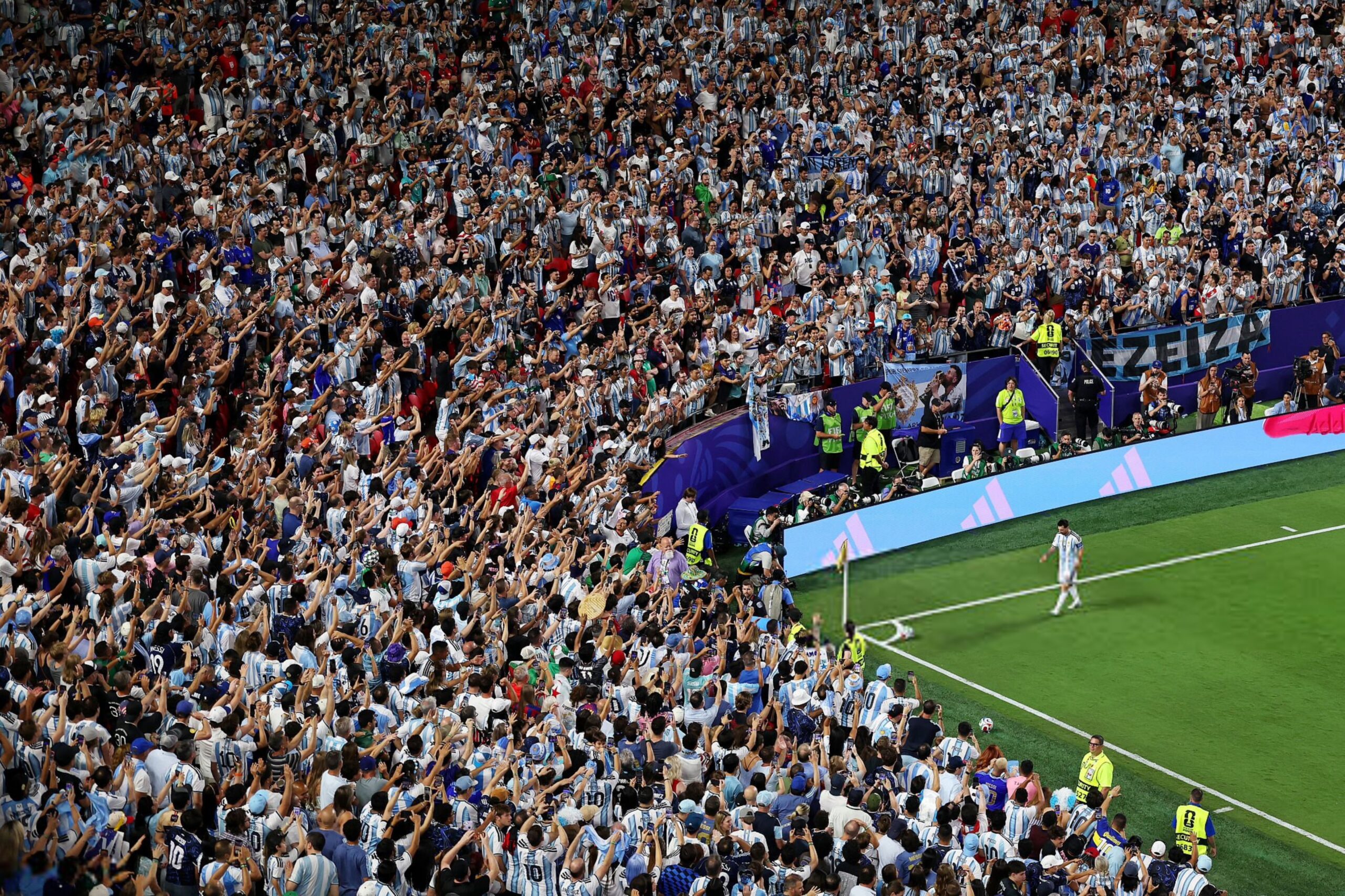
Tonight in Kansas City, on his 200th appearance for Argentina, exactly twenty years after that debut in Gelsenkirchen, Lionel Messi scored a hat-trick. The man who gave him his instructions that evening in Germany now gives them as head coach. The teenager who scored a 6th goal in a match already won has become a 38-year-old who wins matches by himself, before witnesses who travelled to Missouri from across the world simply to be in the same building as him one more time — to be able to say, when this is over, that they were there.
This is what eulogies are for. Not the dead. The irreplaceable. The things we are losing slowly enough that we can see the loss and love them harder for it.
Watch the 18th minute. De Paul delivers a splitting ball that breaks Algeria’s midblock. Messi receives it twenty-five yards from the goal. He shifts onto his left foot — it is always the left foot, has always been the left foot, will forever be the left foot in the memory of everyone who has ever watched him — and curls a strike towards the top-right corner. Algeria’s goalkeeper, Luca Zidane — son of the man whose name became synonymous with football’s grandest stage — gets both hands to it. The strike has too much power. Kansas City Stadium explodes.
It is his 14th World Cup goal. In the 60th minute, it becomes his 15th. In the 76th, his 16th, drawing him level with Miroslav Klose at the summit of the all-time scoring record. A number that has stood since Germany 2014 and now, in the Missouri night, belongs to two men instead of one. By the next match, it will belong to one again. Everyone in that stadium knows which one.
Here is the number that should make you put down whatever you are doing and simply sit with it. Since turning 35, Messi has scored ten World Cup goals — more than Harry Kane, Diego Maradona, Cristiano Ronaldo and Thierry Henry have each scored in their entire World Cup careers.
In the years when most elite players are negotiating with their bodies, when the sport quietly begins to mourn them before they have left, Messi has been scoring at a rate that exceeds the individual lifetime totals of four of the greatest forwards football has ever produced. The conversation about his decline — held with great confidence for at least a decade — is not merely premature. It is one of the most comprehensively, statistically, historically wrong predictions ever made about another human being.
In the 60th minute, a goalkeeper error allowed the ball to roll into his path. He placed it into the net with typical composure — becoming the oldest player to score twice in a World Cup match. That composure is worth dwelling on. It is not the composure of indifference, nor of a man going through motions worn smooth by repetition.
It is the composure of someone who has been in this precise moment — the ball arriving, the goalkeeper out of position, the net waiting — so many times across so many years that his body resolves the decision before his mind is consulted. The muscles remember every time. They do not forget.
When he was substituted, he left the pitch to a standing ovation. His name echoed around Kansas City. Long after the final whistle, thousands of Argentinians stayed — drums beating, voices raised, his name on their backs, his face tattooed on their arms. They called him hero, idol, their son.
Patrick Mahomes, usually the headline act in this building, watched on like everyone else, captivated. The finest quarterback of his generation, in his own arena, reduced to an audience member. That is the measure of the evening.
But the measure of the man is longer than any single evening. It spans the banner in Gelsenkirchen and the trophy in Lusail. It spans six World Cups, two hundred caps, a record now tied and about to be broken. It spans the years of near-misses and the cruelty that attended them — the finals lost, the tournament exits, the summers when the world wrote him off and he returned the following year to make the world look foolish for doing so.
Afterwards, he said: “To enjoy this with my family, with my team-mates, the ones who are always there, is a really beautiful moment. I’m grateful to the fans — once again they’ve shown that Argentina is crazy about this.”
He has always been the most honest of the great ones. No mythology manufactured for public consumption. Just the football, and the gratitude, and the love of it that has carried him from a bench in Gelsenkirchen to a standing ovation in Kansas City, twenty years apart and one goal away from standing alone at the top of the only mountain that was left to climb.
Twenty years ago, in the stands in Germany, Argentine fans held a banner that read: “This Is My Dream.”
The dream is still going.
So is he.
Read also
The Messiah of Naples: Diego Maradona
Unsung Heroes in World Cups: Rob Rensenbrink | 1978 Argentina
Follow Footy Times on Social Media:
Discover more from Footy Times
Subscribe to get the latest posts sent to your email.