

The Vinicius Law: Football’s Most Controversial New Rule Has Already Changed a World Cup

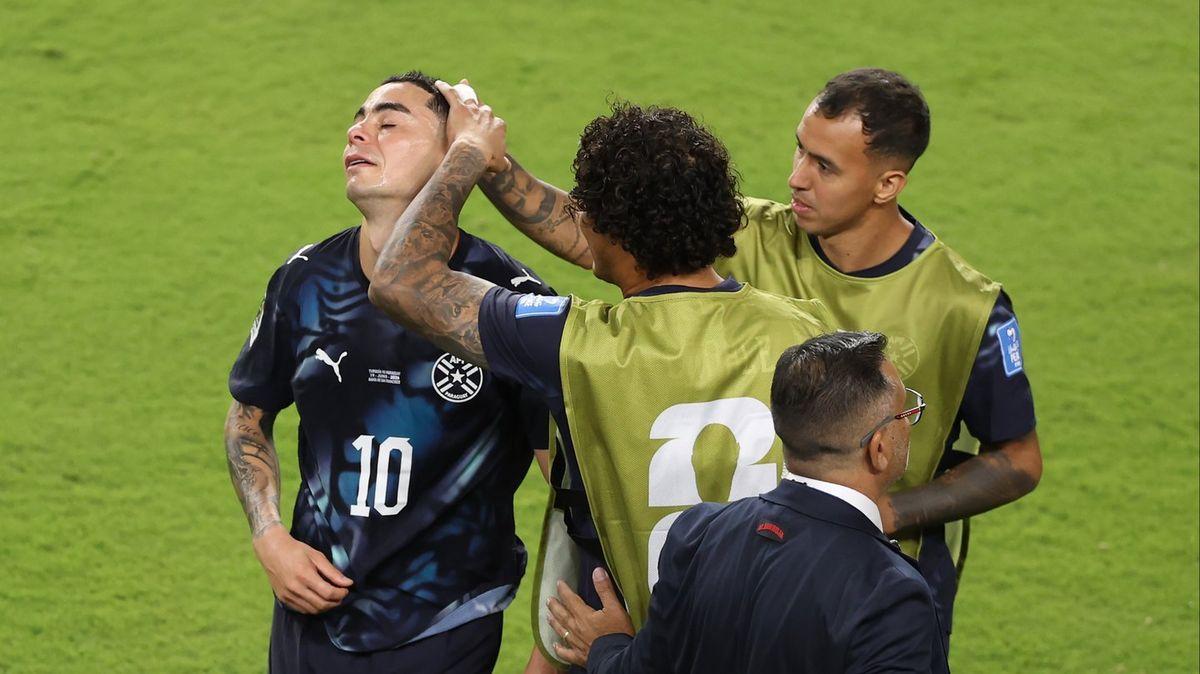
In the 45th minute of a World Cup match in San Francisco on Friday, Miguel Almirón covered his mouth with his hand while saying something to Turkish defender Mert Müldür. VAR intervened. A red card was produced. Paraguay played the second half with ten men and held on to win 1-0, eliminating Turkey from the tournament.
Nobody knows what Almirón said.
That is not a minor detail. It is the central fact around which football’s newest and most divisive rule must be judged.
Where It Came From
On February 17, 2026, Real Madrid played Benfica in the Champions League in Lisbon. During the match, Vinicius Júnior claimed he was racially abused by Benfica’s Gianluca Prestianni. Prestianni covered his mouth with his shirt while speaking to Vinicius. The problem was one that football had stumbled over many times before: without audio, without lip reading, without proof, it was one player’s word against another’s. UEFA eventually suspended Prestianni for three matches for abusive conduct, but the incident exposed a structural gap in football’s disciplinary framework. The mouth-covering had made the abuse unprovable.
FIFA raised the idea of a formal deterrent at a technical meeting ahead of the IFAB annual general meeting. British associations were receptive. An insider referred to it early on as “Vinicius’ Law.” In April 2026, IFAB formally approved the rule: any player who covers their mouth with their hand, arm or shirt while confronting an opponent shall receive a straight red card. The rationale was stated plainly by FIFA’s own president. Gianni Infantino put it this way: “If you do not have something to hide, you don’t hide your mouth when you say something. That’s it, as simple as that.”
Simple. Clean. Logical. And, in application, considerably more complicated than it sounds.
The Problem With the Logic
Infantino’s formulation assumes that covering your mouth is evidence of something worth hiding. But footballers have covered their mouths during conversations on pitches for decades — to prevent opponents overhearing tactical instructions, to shield words from the lip-reading cameras that have become ubiquitous in broadcast coverage, to have a private exchange with a teammate or opponent in a sport that is watched by billions.
The rule’s own language acknowledges this. Players can still cover their mouths for friendly conversations in which they don’t want their lips to be read. The red card applies specifically when the mouth-covering occurs in a confrontational situation with an opponent. That distinction, which sounds clear in a rulebook, is considerably less clear in real time, in the 45th minute of a World Cup match, with 68,000 people watching and VAR officials reviewing footage for a decision that will determine whether a player is ejected from a tournament match.
What counts as confrontational? Who decides? At what point does a heated exchange cross from robust competition into a situation the rule is designed to address? Almirón’s red card produced no answer to any of these questions. It produced a red card, and Turkey, who had a legitimate chance of equalising, ran out of time.
The Case For It
The rule’s defenders have a serious argument, and it should be heard seriously. The problem it was designed to address was real. The Prestianni-Vinicius incident was not an isolated case — it reignited a long-standing discussion about how football handles discriminatory language on the pitch, where the noise of competition and the speed of the game make real-time monitoring almost impossible. Racist, homophobic and abusive language had, for years, found shelter behind covered mouths and deniability. The rule removes that shelter entirely.
That is not a trivial achievement. The sport has spent decades trying to address discriminatory behaviour with tools — camera coverage, post-match disciplinary processes, education campaigns — that consistently proved inadequate. A rule that makes mouth-covering itself the offence sidesteps the evidentiary problem entirely. You do not need to prove what was said. You only need to prove that a mouth was covered in a confrontational situation.
The sanction is initially one match, with a disciplinary committee reviewing the incident for potentially harsher punishment thereafter. In theory, the severity of the response is proportionate to what was said. In practice, a red card during a World Cup group match — with the implications that carries for the match itself, for other players’ booking records, for tournament qualification — is a significant intervention regardless of what follows.
What Almirón’s Red Card Tells Us
Almirón became the first player to receive a red card under the new rule. He is not accused of racism. Nobody has claimed he said anything abusive. He covered his mouth while saying something to an opponent — the act itself, not the content, triggered the sanction. A rule designed to protect Vinicius Júnior from racists sent a South American midfielder off for an unknown communication in a World Cup knockout battle. Turkey, who had hit the woodwork and dominated possession before the red card, could not convert 32 shots and were eliminated.
The rule works, in the sense that it deters. No player watching that red card in San Francisco will cover their mouth near an opponent for the rest of this tournament. The deterrent is absolute. But deterrence without proportionality — punishment for the act rather than the intent — is a blunt instrument in a sport that demands nuance from its officials.
Football has always struggled to balance the need for clear, enforceable rules with the complexity of human behaviour on a pitch. The Vinicius Law is an honest attempt to solve a genuine problem. Whether Almirón’s red card represents justice or collateral damage will ultimately depend on what he said to Müldür.
Nobody knows. That is still the problem.
Read more – Tunisia vs Japan – Preview, Prediction and Team News
Also see – Germany vs Ivory Coast – Preview, Prediction and Team News
Follow Footy Times on Social Media:
Facebook | Instagram | Twitter | YouTube
Discover more from Footy Times
Subscribe to get the latest posts sent to your email.