

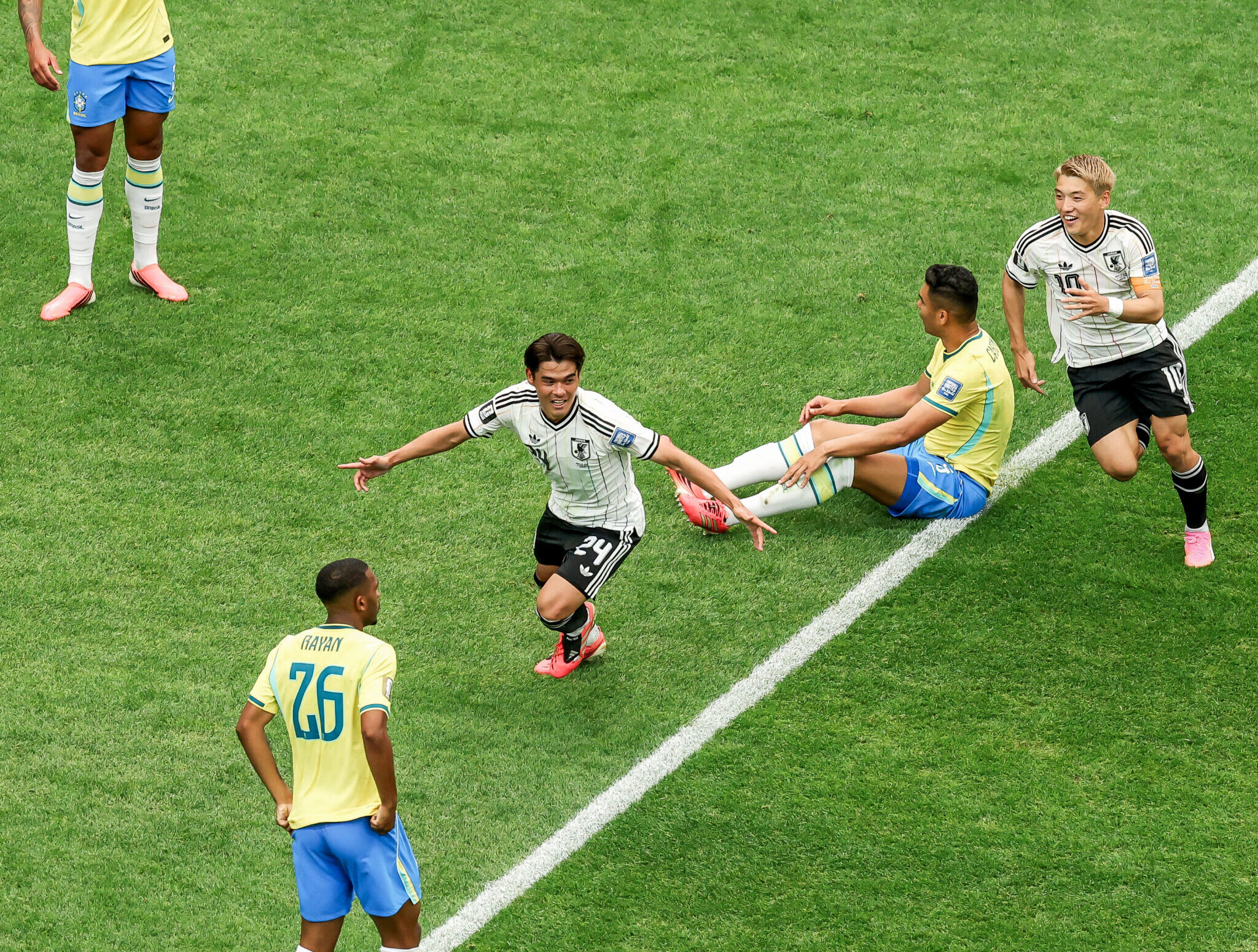

For ninety minutes, Japan made Brazil appear unusually ordinary. South Africa, dismissed by many before kick-off, reduced Canada to a single decisive moment. Paraguay matched Germany stride for stride before eliminating the four-time world champions in a penalty shootout. Morocco not only defeated the Netherlands but outplayed them for long stretches of the contest. Only Brazil eventually progressed, yet even the Seleção spent much of the evening struggling against one of the tournament’s most tactically disciplined sides. The Round of 32 has therefore delivered far more than a collection of surprising scorelines. It has exposed the persistent inequalities embedded within world football and challenged many of the assumptions that continue to shape how success, failure, and style of play are interpreted on the global stage.
One of the most striking features of contemporary football discourse is the language employed whenever nations from Africa, Asia, or parts of Latin America refuse to play according to Europe’s preferred script. Labels such as “parking the bus,” “terrorball,” “anti-football,” or the increasingly popular “Haramball” emerge with remarkable speed whenever these teams defend collectively, compress space, or prioritize tactical discipline over expansive possession. Yet the same vocabulary almost disappears when comparable strategies are adopted by Europe’s most celebrated clubs. José Mourinho’s defensive masterclass with Inter Milan against Barcelona in the 2010 UEFA uefa.com/uefachampionsleague/” target=”_blank” rel=”noopener noreferrer”>Champions League semi-final is remembered as tactical genius. Diego Simeone’s Atlético Madrid have long been praised for their defensive organisation, compactness, and strategic intelligence. Greece’s triumph at UEFA Euro 2004 has entered football folklore as an example of discipline overcoming technical superiority. Identical tactical principles are therefore interpreted through entirely different lenses depending upon who deploys them. The distinction is seldom tactical; rather, it reflects longstanding assumptions about which footballing cultures are considered legitimate producers of sophisticated football.
Such assumptions become even more problematic when viewed alongside the structural inequalities that underpin the global game. The FIFA World Cup is frequently celebrated as football’s great equaliser, a tournament in which every nation begins with identical aspirations. Yet beyond the ninety minutes played on the pitch, international football operates within an economic system characterised by profound imbalance. Europe overwhelmingly controls the financial centre of world football through its elite domestic leagues, commercial broadcasting agreements, sponsorship markets, sports science infrastructure, coaching education, medical facilities, scouting networks, and transfer economy. Even within Europe itself, governing bodies and financial reports increasingly acknowledge that competitive balance has become concentrated among a relatively small group of wealthy clubs whose revenues continue to outpace the rest of the continent. If inequality has become a defining feature within European football itself, then the structural disadvantages confronting federations across Africa, Asia, and much of Latin America become even more pronounced.
These disparities are reinforced through the global circulation of football labour. Long before international tournaments begin, talented players from less affluent footballing regions are identified at increasingly younger ages and incorporated into European academy systems. European clubs acquire potential, European leagues develop elite performance, European broadcasters commercialise that talent, and European football ultimately captures the greatest financial returns. Academic scholarship has frequently described this movement as a form of unequal exchange in which footballing labour flows systematically from peripheral football economies toward the sport’s economic core. Such analyses do not suggest moral failure on the part of European clubs; rather, they demonstrate how the contemporary football economy is structured in ways that consistently privilege already dominant institutions. Development pathways therefore exist, but they remain deeply asymmetrical.
This distinction between development and equality is fundamental. Football development programmes have undoubtedly generated significant social benefits across the world. Investment in grassroots coaching, youth education, women’s football, public health initiatives, and community participation has expanded opportunities for millions. In many societies, football functions as an important vehicle for education, inclusion, and social mobility. Yet development should not be mistaken for competitive equality. A nation may successfully produce world-class footballers while simultaneously lacking financially sustainable domestic leagues capable of retaining them. It may invest heavily in youth development only to lose its brightest prospects before they contribute meaningfully to the local football ecosystem. Progress, therefore, does not necessarily dismantle structural dependency.
It is precisely within this context that the FIFA World Cup assumes such distinctive significance. Unlike club football, international competition temporarily suspends the transfer market. No federation can strengthen its squad through January signings, purchase greater tactical depth, or compensate for structural deficiencies with financial expenditure. National teams compete with the players produced by their own football systems, and while historical inequalities remain visible, the relative advantages of wealth become substantially compressed. Organisation, collective discipline, tactical flexibility, and psychological resilience consequently acquire heightened importance. For nations unable to overwhelm opponents through squad depth or financial resources, collective organisation becomes the principal mechanism through which structural disadvantage can be reduced.
Morocco’s victory over the Netherlands provides perhaps the clearest illustration of this dynamic. Popular narratives quickly attempted to frame the Atlas Lions’ success as another example of supposedly negative football frustrating technically superior European opposition. Yet the statistical evidence points in precisely the opposite direction. Morocco finished with approximately seventy per cent possession, registered more attempts on goal, created twice as many shots on target, completed close to eight hundred passes with outstanding accuracy, and forced more corner kicks than their opponents. Rather than surviving through defensive resistance, Morocco controlled territory, dictated possession, and consistently imposed their own rhythm upon the match. The eventual penalty shootout reflected Dutch defensive resilience rather than Moroccan fortune. To characterise such a performance as “Haramball” is therefore not merely misleading—it fundamentally reverses the empirical reality of what occurred. Morocco did not resist superior football; they produced it.
Paraguay’s elimination of Germany demonstrated a different, though equally sophisticated, form of tactical excellence. Germany controlled possession for extended periods, yet possession alone revealed remarkably little about the contest itself. Paraguay repeatedly disrupted attacking sequences through disciplined defensive positioning, intelligent pressing triggers, and exceptional concentration. Every interception interrupted momentum, every clearance provided psychological relief, and every defensive duel represented another incremental victory within a larger strategic contest. Penalty shootouts often appear random to casual observers, but they are rarely detached from the preceding 120 minutes. Teams reach penalties by successfully imposing tactical resilience over prolonged periods, and Paraguay earned that opportunity through organisation rather than chance.
Japan’s performance against Brazil perhaps offers the most compelling indication that football’s traditional hierarchy is undergoing gradual transformation. Although Brazil ultimately progressed, Japan dictated something arguably more significant than possession statistics—they dictated Brazil’s rhythm. The Seleção struggled to establish sustained attacking fluency, their most creative players frequently received possession in harmless areas, and clear scoring opportunities remained remarkably limited throughout much of the contest. Japan’s collective pressing, technical precision, physical conditioning, and positional discipline reflected decades of sustained investment in coaching education and tactical development across Asian football. While the final result recorded another Brazilian victory, the performance itself suggested that the competitive distance separating established powers from emerging football nations continues to narrow.
These developments challenge long-standing assumptions embedded within international football discourse. For decades, global football narratives have frequently been constructed around European norms: Europe attacks while others react; Europe innovates while others imitate; Europe entertains while others defend. The 2026 FIFA World Cup increasingly undermines those binaries. African nations have demonstrated sophisticated tactical organisation and technical confidence. Asian teams have combined positional intelligence with fearless attacking football. Latin American outsiders continue to exhibit extraordinary resilience and adaptability despite operating within comparatively constrained football economies. Collectively, these performances suggest that footballing excellence is no longer monopolised by traditional centres of power but is emerging through increasingly diverse tactical cultures across the globe.
Criticism directed toward supposedly cautious football therefore overlooks an essential principle of sporting competition: strategy is inseparable from context. No serious observer expects a lightweight boxer to exchange punches recklessly with a heavyweight, nor would anyone expect a midfield Formula One team to replicate the race strategy of Red Bull or Ferrari. Throughout sporting history, successful competitors have adapted their methods according to available resources, relative strengths, and competitive circumstances. Football should be no different. To criticise Morocco, Paraguay, South Africa, or Japan for selecting strategies appropriate to their contexts is not merely tactically simplistic; it reflects a failure to appreciate how competition itself operates.
Perhaps the most important outcome of this World Cup therefore lies beyond the individual scorelines. The tournament has exposed the growing fragility of football’s traditional certainties. Europe continues to dominate the sport economically, its clubs remain the principal destination for elite talent, and its leagues still command unparalleled financial resources. Yet the knockout stage has once again demonstrated that wealth alone cannot determine international competition. Tactical organisation can unsettle technical superiority, collective discipline can neutralise individual brilliance, and carefully constructed game plans can undermine vastly greater financial power. The World Cup continues to remind football of one of its oldest and most democratic truths: success belongs not simply to those with the greatest resources, but to those capable of adapting most intelligently to the contest before them. Nations from Africa, Asia, and Latin America are no longer requesting recognition within world football’s established hierarchy. Increasingly, they are rewriting it on the pitch.
Discover more from Footy Times
Subscribe to get the latest posts sent to your email.