


In November 2022, the captains of seven European nations planned to wear a rainbow-coloured armband at the World Cup in Qatar. It bore a small multicoloured heart and the words “OneLove.” It symbolised, its organisers said, inclusion and diversity. FIFA threatened disciplinary action — a yellow card for any captain who wore it on the field of play. The federations backed down within hours. Some players covered their mouths in protest photographs. Statements were released. The moral temperature of European football reached something close to a boil.
The 2026 World Cup opens on 11 June in the United States. In the days before it, an African referee was turned away at an American airport. An Iraqi striker was held for seven hours. A team photographer was detained for ten and then deported. Senegalese players in the prime of their careers were searched on a tarmac in San Antonio, shoes off, bags open, in full view of airport staff and journalists. FIFA’s response to all of this has been a corporate shrug, a reference to host country immigration sovereignty, and a statement assuring the world that the tournament will be “great.”
The comparison is not merely uncomfortable. It is, as a matter of documented fact, the central story of football’s relationship with power in the twenty-first century. That story is about whose discomfort matters, whose dignity is protected, and how consistently the sport’s governing structures find ways to challenge the powerful only when doing so costs nothing.
The Architecture of Selective Outrage
The Qatar campaign was twelve years in the making. From the moment the 2010 bid was announced, European football’s institutions — federations, media, supporter groups, governing bodies — built a sustained and increasingly vocal case against the tournament. The concerns were real: the Guardian documented that at least 6,500 migrant workers from India, Pakistan, Nepal, Bangladesh and Sri Lanka had died in Qatar since 2010. A senior Qatari official eventually acknowledged the figure of World Cup-related worker deaths was between 400 and 500, a number many researchers still consider conservative. Same-sex relationships were criminalised. Press freedom was constrained.
None of these concerns were invented. All of them were legitimate. But when the 2018 World Cup was held in Russia — while that government was persecuting LGBTQ citizens, suppressing dissent, and occupying Ukrainian territory — the moral energy of European football was markedly lower. When the 2022 Winter Olympics took place in Beijing, amid a UN-documented situation in Xinjiang that multiple governments had described as genocide, the armband campaigns did not materialise. The sustained, coordinated, multi-year pressure campaign that Qatar received was applied with a selectivity that deserved examination then, and deserves it even more now.
Gianni Infantino, in a pre-tournament press conference in Doha, made this point with characteristic intemperance: “For what we Europeans have been doing in the last 3,000 years around the world, we should be apologising for the next 3,000 years before starting to give moral lessons.” The argument was deployed to protect FIFA and Qatar from accountability, which made it dishonest in its application even when it contained a grain of historical truth. European football’s conscience has a geography. It operates most loudly at a cultural distance. It finds it considerably harder to speak when the subject is an ally, a trading partner, or a country whose media rights are integral to the sport’s commercial survival.
That geography has never been more legible than in the days before this tournament.
A Peace Prize Made to Order
Before examining what is happening in American airports and on American tarmacs, it is necessary to understand what FIFA did in December 2025, because it explains everything that followed.
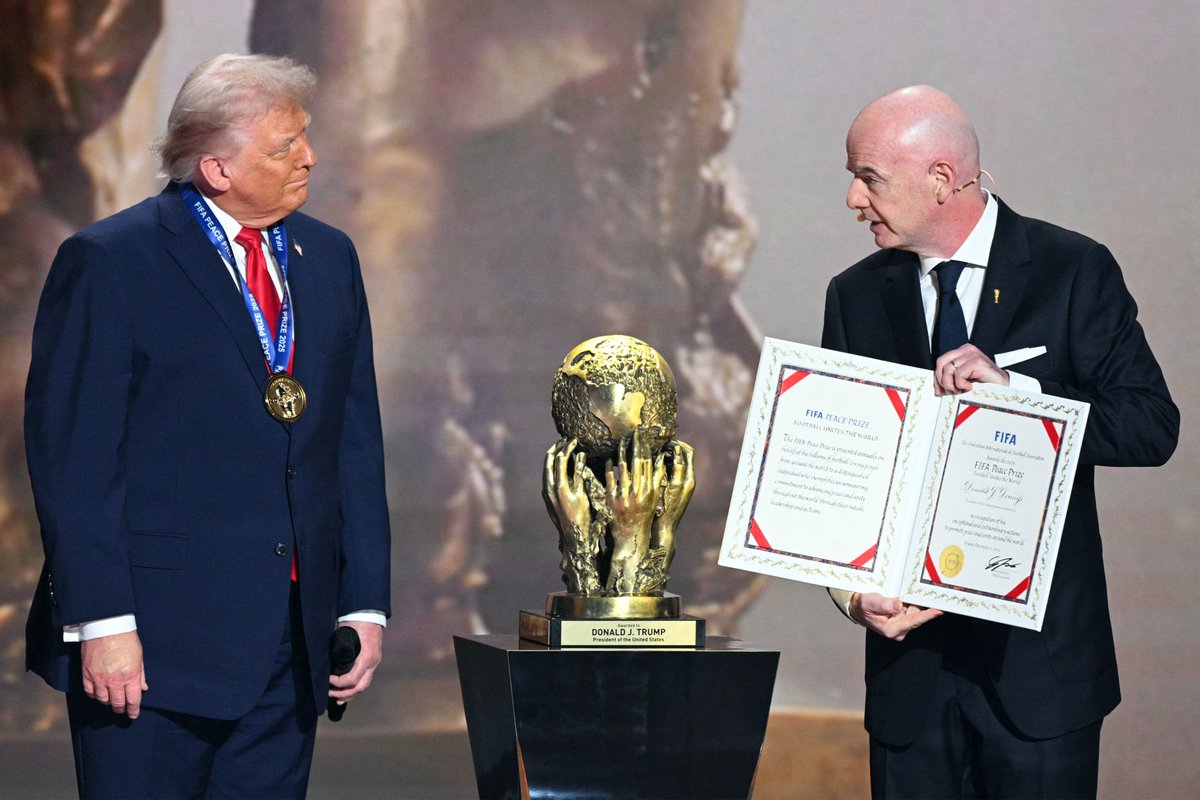
At the World Cup draw ceremony inside the Kennedy Center in Washington, Infantino presented Donald Trump with an award called the FIFA Peace Prize — officially titled “Football Unites the World.” The prize had been announced in early November, three weeks after Trump was passed over for the Nobel Peace Prize, which he had publicly coveted. There was no published criteria, no independent jury, no shortlist. FIFA’s Council and vice presidents were not consulted or involved in its creation. Senior officials were surprised by the announcement. Infantino had previously posted on Instagram that Trump “definitely deserves the Nobel Peace Prize.”
This is the same organisation that threatened players with a yellow card for wearing a coloured armband in Qatar. It created a bespoke honour, without institutional process, for the sitting head of government of the country hosting its most commercially significant tournament in history — a man whose administration was, at the time of the presentation, engaged in mass deportations, the suppression of protest, and an active rollback of transgender rights. Australian footballer Jackson Irvine publicly accused FIFA of making a mockery of its own Human Rights Policy. Norway’s football federation formally supported a complaint by human rights organisation FairSquare alleging that Infantino had breached FIFA’s own ethics bylaws, which require political neutrality and carry potential two-year bans for violations.
FIFA did not respond meaningfully to any of it. The peace prize remained. The tournament proceeded. The relationship between Infantino and the White House deepened. The governing body that sanctioned players for symbols of inclusion had rewarded a government overseeing what Amnesty International formally described as “a human rights emergency.”
Iran: Playing in the Country That Bombed You
There is no precedent in World Cup history for what the Iranian football team is being asked to do this summer.
On 28 February 2026, the United States and Israel launched military strikes on Iran, killing Supreme Leader Ayatollah Ali Khamenei and other senior officials. Iran responded with missile and drone strikes targeting Israel, US military bases in the Middle East, and energy infrastructure across the region. A ceasefire is nominally in place but hostilities remain stubbornly unresolved, with Iran maintaining pressure on the Strait of Hormuz and the US imposing a naval blockade on Iranian ports. More than 1,200 Iranians had died in the initial attacks by the time Iran’s sports minister made his announcement.
Iran’s sports minister initially declared, on state television, that the country could not participate in a World Cup hosted by a country that had just attacked it. The Iranian football federation’s president said: “What is certain is that after this attack, we cannot be expected to look forward to the World Cup with hope. The US regime has attacked our homeland, and this is an incident that will not go unanswered.” The White House World Cup task force director’s response, posted on social media the same day: “We’ll deal with soccer games tomorrow — tonight, we celebrate their opportunity for freedom.”
Iran eventually opted to participate, their players describing the tournament as something they were doing for their suffering people. “We know that our people have been going through a lot of difficulties throughout the war, and we are going there for them,” one player said. Their team base is in Mexico, because 14 members of Iran’s support staff were denied US visas altogether, and the federation negotiated at the last minute to relocate across the border. All of Iran’s group-stage matches are scheduled on the West Coast of the United States — the country that is still, technically, at war with them.
FIFA’s position throughout was that it was “monitoring the situation.” It did not call for the tournament to be moved. It did not demand the US government provide security guarantees for a team whose country it had just bombed. It did not invoke any of the human rights language it deploys so readily in other contexts. It monitored.
The Tarmac in San Antonio
On the eve of the tournament, a video circulated online that stopped people. It showed members of Senegal’s national football team — a squad containing Premier League stars, African Cup of Nations champions, elite professional athletes at the peak of their careers — standing on an airport tarmac in San Antonio, Texas. They were asked to take off their shoes and show the contents of their bags, searched right there on the runway. Uzbekistan’s squad faced drug-sniffing dogs and metal detector checks upon arriving at their training facility in New York.
The footage was described as “disgraceful” across social media. One fan wrote: “The Senegalese delegation gets this treatment on arrival in the USA. Full tarmac searches, shoes off, bags turned inside out like criminals. This is straight up humiliation and a disgrace.” Another supporter added: “I’ve never seen passengers on a private charter flight get searched like that, and I’ve been working in the sector for 15 years.” Senegalese supporters asked the obvious question: would Lionel Messi’s Argentina be searched the same way? Would the German squad be asked to remove their shoes on a runway? The answer, of course, is known without asking.
Senegal is on the Trump administration’s partial travel restriction list. Fans of Senegal and Côte d’Ivoire were effectively barred from attending their team’s matches in the US unless they held pre-existing visas, as both countries were added to the restriction list in December 2025. The players were given special exemptions. The fans were not. The players were then treated, on arrival, as though the exemptions were provisional and their presence suspicious.
The asymmetry is not accidental. It is structural. It follows the lines of a world in which certain passports, certain names, certain complexions, and certain national affiliations are processed as potential threats until proven otherwise — and in which a global football tournament, promised by its governing body to be “the most inclusive in history,” operates within that structure without meaningful challenge.
Players and Officials Turned Away
The Senegal tarmac was not an isolated incident. It was the visible surface of a pattern that had been building for months.
Omar Abdulkadir Artan, one of Africa’s finest referees, arrived at Miami International Airport carrying valid travel documents, ready to become the first Somali to officiate a World Cup match. He was turned away. Somalia is on Trump’s travel ban list. Trump had previously called Somali immigrants in the US “garbage.” FIFA confirmed his exclusion in a statement that managed, in a single paragraph, to express regret and wash its hands entirely: “FIFA is not involved in host country immigration processes, including visa adjudications.” It had, apparently, not anticipated that awarding a World Cup to a country with sweeping travel bans on nations that had qualified for that tournament might create complications for match officials from those nations.
Iraq’s striker Aymen Hussein — the man who scored the goal that sent Iraq to their first World Cup in forty years — was detained at Chicago’s O’Hare International Airport and questioned for nearly seven hours. The team’s official photographer, Talal Salah, was held for more than ten hours, had his electronic devices inspected, and was formally denied entry to the United States. Iraq will play their World Cup matches without their photographer. The images of their historic return to the tournament, forty years in the making, will be made by someone else, or not at all.
New York Mayor Zohran Mamdani described the situation plainly: “The denial of visas for journalists from certain countries, or the rejection of a visa for a coach of a team, as well as single-day visas for specific foreign national teams — this is anathema to what this tournament is supposed to be about.”
FIFA’s Empty Promise and Football’s Real Hierarchy
Amnesty International’s head of economic and social justice put the scale of what is happening in the US in terms that are worth sitting with: “The US Government has deported more than 500,000 people from the USA in 2025 — more than six times as many people than will watch the World Cup final in the MetLife Stadium.” More than 120 civil society organisations issued a formal travel advisory warning fans, players, journalists and visitors of serious rights violations. “With less than two months to go, we are still waiting for public commitments from FIFA and host city organizers about plans to protect residents, workers, and visitors,” said Jennifer Li of the Dignity 2026 coalition. “The silence has been deafening.”
It is the silence that is the story. Not a silence born of ignorance — every major human rights organisation on the planet has filed formal statements, sent letters, issued reports. A deliberate silence. The silence of an institution that knows exactly what is happening, has chosen its commercial and political alignments carefully, and has calculated that the cost of speaking is higher than the cost of watching.
When Qatar was the subject, FIFA threatened yellow cards. When the United States is the subject, FIFA invents a peace prize and refers to “host country sovereignty.” The mechanism is different. The function is identical: protecting the powerful from accountability, leaving the vulnerable to manage on their own.
European federations that spent years building moral cases against a Gulf state have been notably quiet about a striker questioned for seven hours, a referee turned away at the door, or football players searched like suspects on a runway. The armbands are in a drawer somewhere. The statements of principle are in the archive. The tournament is on.
Football does not have a conscience. It has always had interests. What changes, from tournament to tournament and host to host, is how loudly it chooses to pretend otherwise.
Will the Hands Go Up?
Which brings us back to the question that the photograph from Doha leaves hanging in the air. In 2022, eleven German players stood in a line and covered their mouths. They said FIFA had silenced them. They said human rights were non-negotiable. They said denying them a voice was unacceptable. The image travelled around the world.
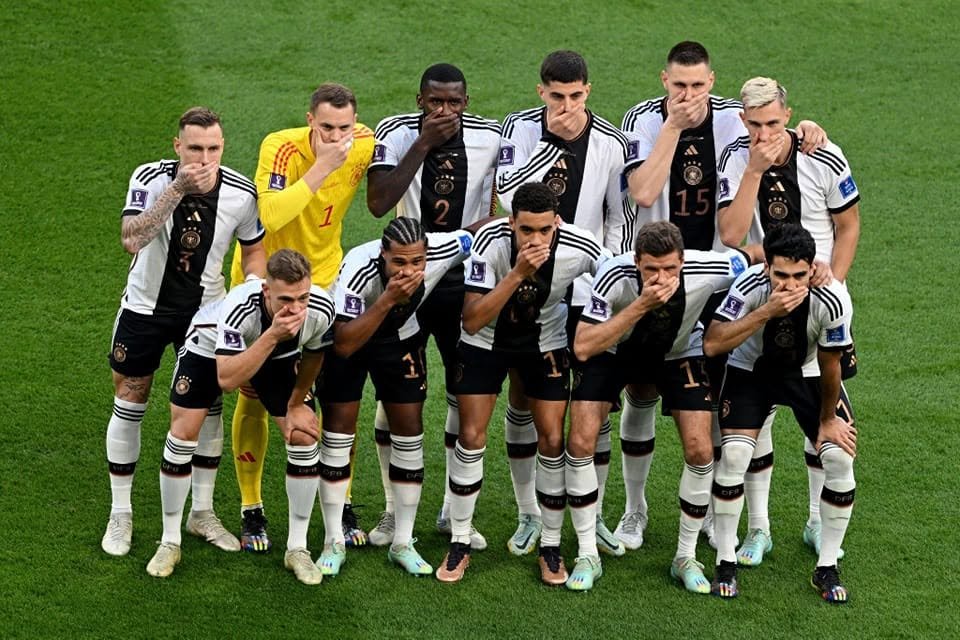
On 11 June 2026, those same players — or their successors in the same white shirts — will line up for their team photograph in an American stadium. A Somali referee will not be there to officiate, turned away at Miami Airport. An Iraqi photographer will not be there to document it, deported from Chicago after ten hours of interrogation. Senegalese players will have arrived having been searched on a tarmac like cargo. Iranian footballers will have flown in from a country their hosts bombed four months ago, to play in the country that bombed it.
The photographers will be ready. The moment will come.
Will the hands go up?
Read more – FIFA Revokes Iran Fans’ World Cup Tickets, Says Federation
Also see – African Referee Omar Abdulkadir Artan Denied Entry to US for 2026 FIFA World Cup
Follow Footy Times on Social Media:
Facebook | Instagram | Twitter | YouTube
Discover more from Footy Times
Subscribe to get the latest posts sent to your email.