

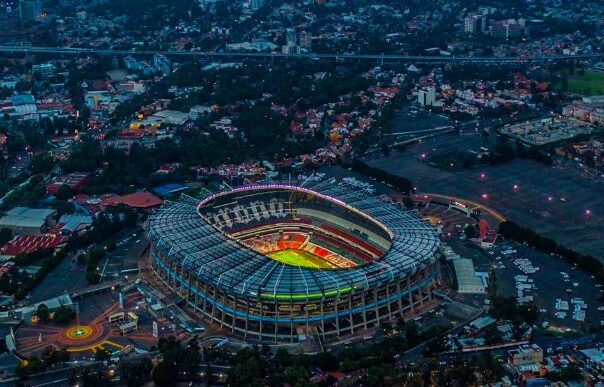

Few stadiums in world football possess the aura, history, and mythology of the Estadio Azteca. Towering above the southern district of Mexico City at an altitude of more than 2,200 metres (7,220 feet), the iconic venue has witnessed some of the greatest moments in sporting history and remains one of the most revered football arenas ever built.
As the 2026 FIFA World Cup returns to Mexico, the Azteca once again stands at the centre of global football, welcoming another generation of players to a stadium where legends have been made.
A Stadium Built for Greatness
Officially opened in 1966, the Estadio Azteca was designed by renowned Mexican architect Pedro Ramírez Vázquez. Constructed specifically to host the 1970 FIFA World Cup, the stadium was envisioned as a venue capable of matching the grandeur of Brazil‘s Maracanã while providing every spectator with an unobstructed view of the action.
Its revolutionary cantilevered roof, steep stands, and bowl-shaped design create an atmosphere unlike any other. Originally accommodating well over 100,000 spectators, successive renovations have modernised the stadium while reducing its capacity to approximately 87,500.
Despite these changes, the Azteca has retained the architectural features that make it one of football’s most intimidating venues.
The Only Stadium to Host Three FIFA World Cups
The Estadio Azteca holds a unique distinction in football history. It is the only stadium ever to host matches in three separate FIFA World Cups—1970, 1986, and 2026.
Each tournament has added another layer to its remarkable legacy.
In 1970, Brazil’s legendary side, led by Pelé, defeated Italy 4–1 in the World Cup final. The tournament is remembered for Brazil’s breathtaking football, culminating in Carlos Alberto’s iconic team goal—widely regarded as one of the greatest goals ever scored.
Sixteen years later, the Azteca witnessed another defining chapter in football history.
During the 1986 World Cup quarter-final against England, Diego Maradona produced two of the most famous goals the sport has ever seen. The first, later known as the “Hand of God,” remains one of football’s most controversial moments. Minutes later, Maradona dribbled past five England players before scoring what FIFA later recognised as the “Goal of the Century.”
Few venues can claim to have crowned both Pelé and Maradona, two players often considered the greatest footballers of all time.
Mexico’s Fortress
For the Mexican national team, the Azteca has long been an almost impenetrable fortress.
Since becoming their home in 1966, Mexico have won the overwhelming majority of their competitive fixtures there. The combination of passionate home support and the challenging high-altitude conditions has made visiting teams struggle for decades.
Playing at over 2,200 metres above sea level means thinner air and lower oxygen levels, often causing fatigue among players unfamiliar with such conditions. Sports scientists believe this physiological challenge gives Mexico a significant home advantage, particularly against teams arriving from sea-level environments.
The Famous Azteca Atmosphere
The Azteca is celebrated not only for its history but also for its extraordinary atmosphere.
Teams enter the stadium through underground tunnels before emerging onto the pitch amid deafening noise generated by tens of thousands of supporters. Players frequently describe the experience as overwhelming, with the sound reverberating throughout the enclosed structure.
The passionate Mexican supporters have turned the stadium into one of the most intimidating venues in international football, where the energy of the crowd often becomes an additional player on the field.
More Than Just Football
Although primarily known as a football stadium, the Azteca has also hosted some of the largest sporting and cultural events in history.
In 1993, more than 132,000 spectators packed the stadium to watch Mexican boxing legend Julio César Chávez defend his world title, creating one of the largest attendances ever recorded for a championship boxing match.
The venue has also welcomed global entertainment icons. Michael Jackson performed five sold-out concerts there during his Dangerous World Tour, while Pope John Paul II celebrated a historic mass before more than 110,000 worshippers in 1999.
These events underline the Azteca’s status as one of the world’s premier gathering places, transcending sport to become a symbol of Mexican culture.
A Living Monument to Football
Few stadiums possess a history comparable to the Estadio Azteca. From Pelé lifting his third World Cup to Maradona producing football’s most unforgettable performance, its pitch has hosted moments that have shaped the sport itself.
As another generation of stars walks through its famous tunnel during the 2026 FIFA World Cup, the Azteca remains more than simply a stadium. It is football’s grandest stage—a living monument where history, passion, and greatness continue to meet.
Discover more from Footy Times
Subscribe to get the latest posts sent to your email.