

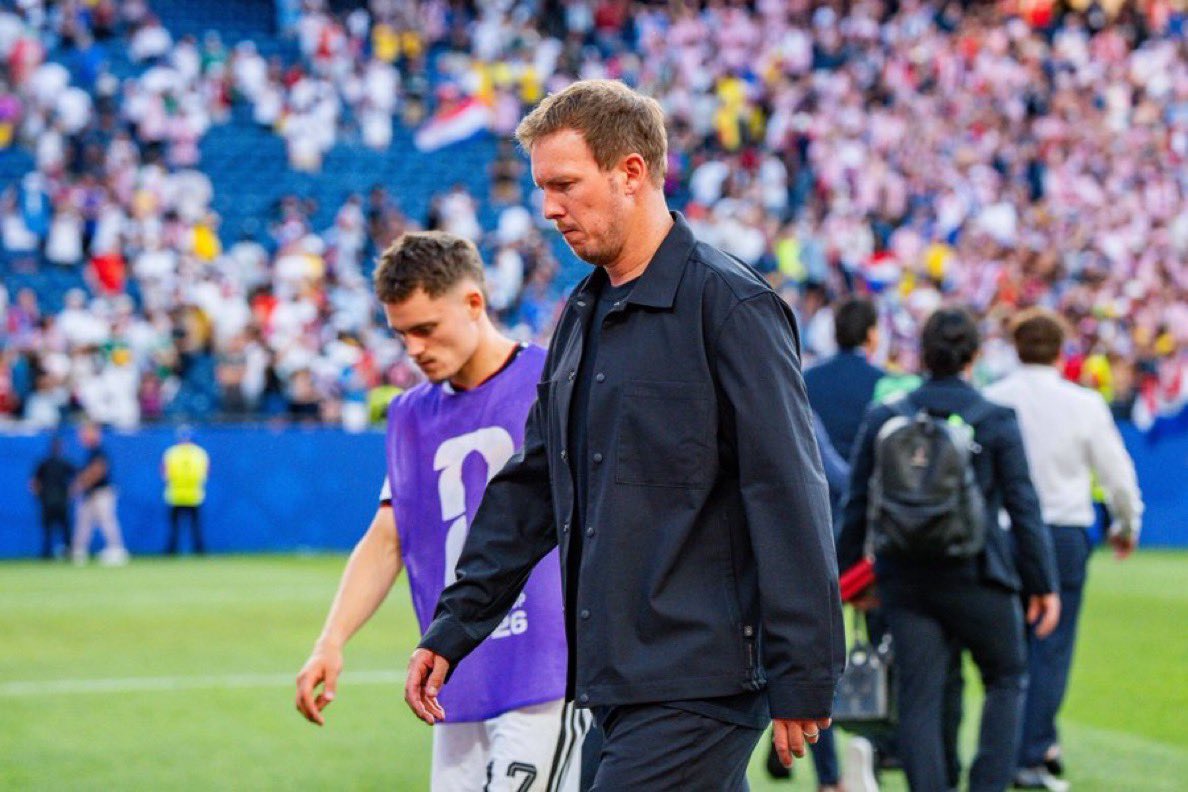

The numbers from Boston Stadium tell a particular kind of story before a single headline is read. Germany completed 719 passes to Paraguay’s 161. They had 21 shots. They lost anyway, beaten 4-3 on penalties after a 1-1 draw, eliminated in the Round of 32 by a team ranked 41st in the world. German football journalism does not need embellishment to make that defeat sound damning. The facts alone do the work. What followed on Tuesday morning was a press response that went looking for something deeper than a bad night — and found it.
‘Slow. Boring. Lethargic.’
Bild, Germany’s largest tabloid, did not soften its assessment. The performance was “truly awful,” the paper wrote — “slow,” “boring.” Its fuller verdict read: “A disastrous performance… In their first World Cup knockout match since winning the title in 2014, Julian Nagelsmann’s team delivered a truly awful performance for much of the game. Slow. Boring. Lethargic. It’s another German football nightmare!”
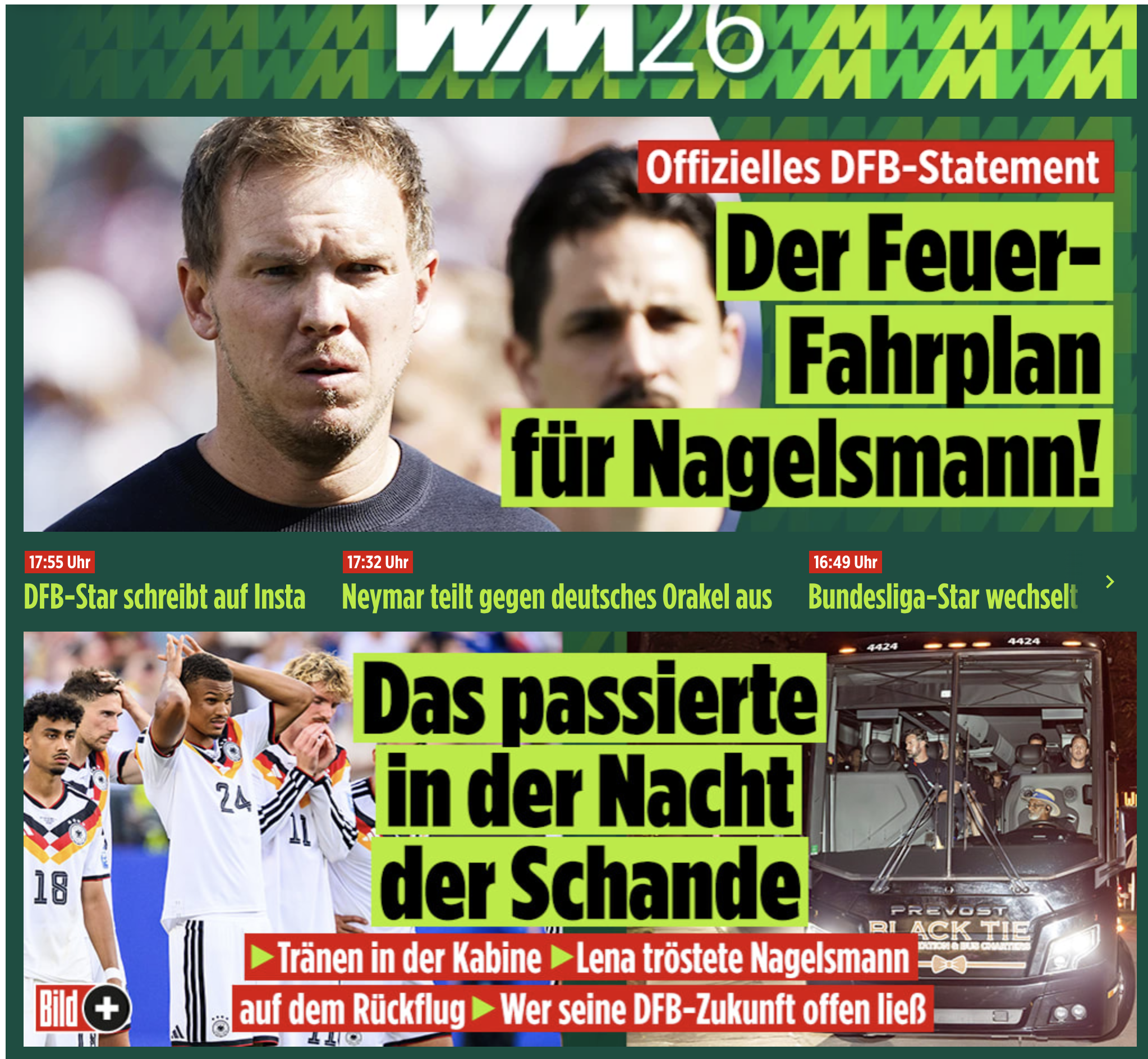
That phrase — another German football nightmare — became the framing device for the entire morning’s coverage, repeated and echoed across outlets that do not often agree on much. It captured something specific: not shock at a single result, but exhaustion at a pattern that keeps recurring with the predictability of a recurring dream nobody can wake from.
‘A New Humiliation’
Süddeutsche Zeitung, the respected Munich daily, called the result “a new humiliation,” adding that Germany were “heading home with a thoroughly deserved return ticket.” The paper went further still, arguing that this exit was even more embarrassing than the group-stage elimination at Qatar 2022 — because in Qatar, Germany had at least been somewhat unlucky. There was no equivalent excuse available this time.
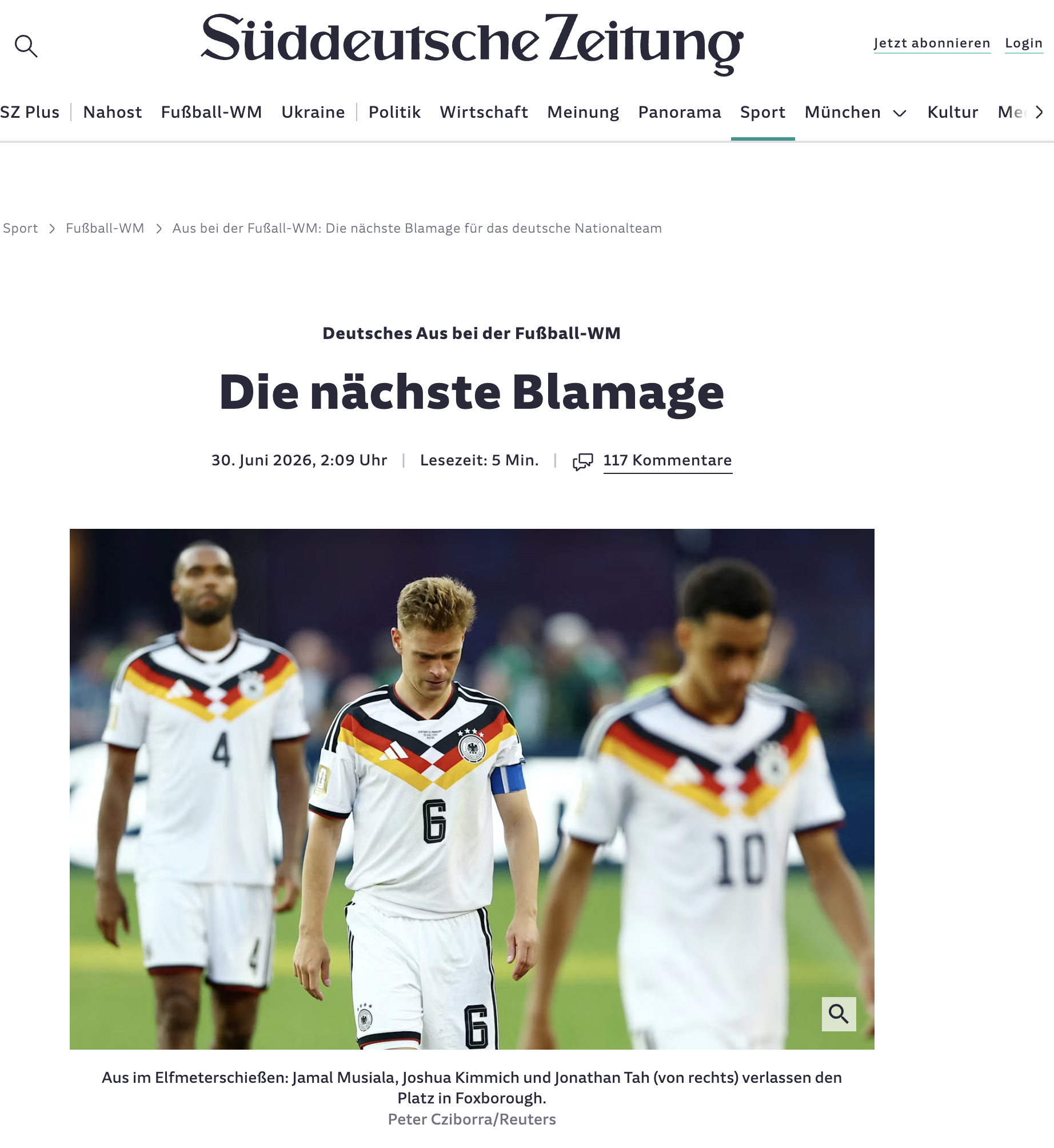
That distinction matters. German football’s relationship with its recent failures has, until now, retained a sliver of plausible deniability — bad luck, a difficult group, a refereeing decision. Süddeutsche’s verdict removed that cushion entirely. Spiegel went further into structural territory, describing the result as “the decline of a once great football nation,” and stating plainly that the World Cup failure “bears the name Nagelsmann.”
‘Drifting Further From the World’s Elite’
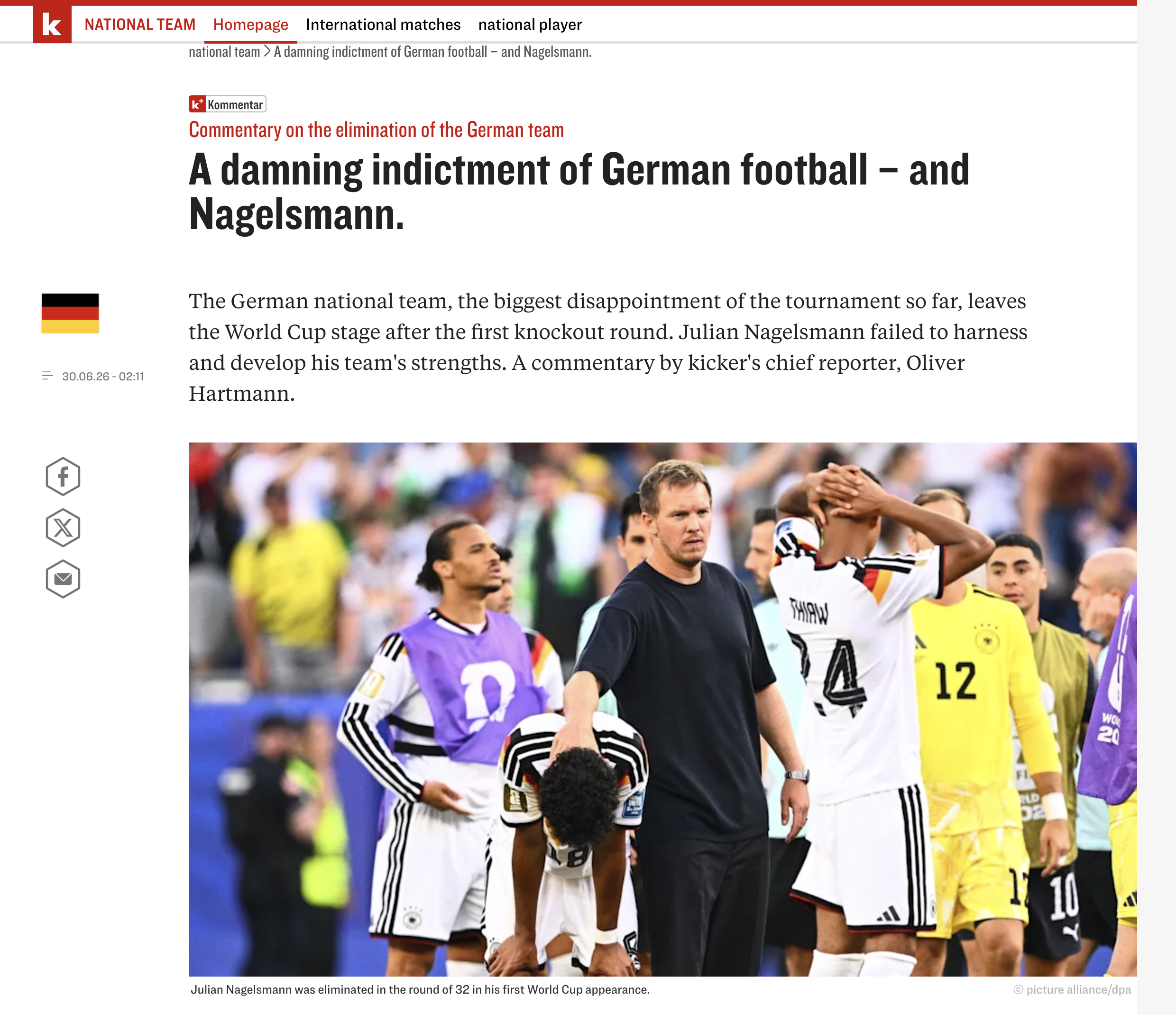
Kicker, Germany’s most authoritative football magazine, delivered perhaps the bluntest single verdict of the morning: “a damning indictment and proof that Germany is drifting further and further away from the world’s elite.” The magazine situated the defeat within a longer decline — noting that Germany’s once-envied ability to produce elite young talent has fallen behind France, Spain and England over the past decade, despite remaining Europe’s most populous football nation.
Sky Sport Germany, surveying the wreckage of Nagelsmann’s tenure, offered a verdict that read as much like a closing argument as analysis: “The end, however bitter it may have been, is no surprise. Therefore, things cannot continue as they are.” Former international Dietmar Hamann gave a similarly blunt assessment in the same coverage, pointing the finger directly at the head coach.
‘They Have Lost All Sense of Their Former Glory’
Die Zeit’s football writer Christian Spiller produced perhaps the most literary indictment of the morning, accusing the team of “a lack of imagination” and of effectively beating themselves. “They have lost all sense of their former glory,” he wrote — extending the criticism beyond the national team itself to a wider decline in German football he located even within the country’s flagship club, Bayern Munich.
That detail — reaching past the national team to question the health of the domestic game’s most successful institution — signals how far this reckoning has travelled in German football discourse. This was no longer simply a conversation about Nagelsmann’s tactics. It had become a conversation about the foundations beneath the entire system.
Klopp’s Intervention: ‘We Were Germany’
Perhaps the most resonant single voice in the aftermath belonged not to a newspaper but to a man working as a television pundit. Jürgen Klopp, watching Paraguay’s celebrations on screen, drew a contrast that cut deeper than any tactical critique. “Look at Paraguay,” he said. “They’re all in tears; that’s how much the Round of 16 means to them.”
Klopp’s diagnosis of Germany’s deeper problem was direct: the team had become too content to coast on its golden past. “We are Germany? No, we were Germany,” he said. “To be football Germany again, we need to really change things.” He was careful, even in delivering that verdict, not to make it personal. “It’s of course not about names. Not about mine, not about Julian’s,” he added — before offering a more measured assessment of the team itself: “Julian is right. The team wanted it, but they were unable to do it in some areas.”
The View From Outside Germany
The international press treated the result as one of the genuine shocks of the tournament. French outlet L’Equipe called it the “biggest shock of the World Cup so far.” Italy’s Gazzetta dello Sport chose instead to praise the victors, writing that Paraguay “fought with great heart and determination for every ball.” Spain’s Marca was the most blunt of all the foreign papers, its headline reading simply: “There’s nothing left of Germany.”
That a four-time World Cup winner could be summarised, by a major European sports daily, in five words of total dismissal is itself a measure of how completely the old assumptions about German football have collapsed in the space of three tournaments.
What the Coverage Adds Up To
Read together, the German press reaction on Tuesday morning was not a pile-on built from outrage alone. It was something more coherent and, in its way, more damning: a consensus, arrived at independently by outlets with very different editorial traditions — Bild’s tabloid bluntness, Süddeutsche’s broadsheet gravity, Spiegel’s structural analysis, Kicker’s specialist authority, Die Zeit’s literary indictment — that the problem facing German football is no longer a single bad result, a single bad tournament, or a single underperforming coach.
It is, in the words echoed across nearly every major German outlet that morning, something closer to a nightmare that keeps returning. The only question the coverage left genuinely open was whether anyone in German football yet has the will, or the plan, to finally wake up from it.
Read more – Germany’s Decade of Decline Reaches Its Lowest Point
Also see – Paraguay Stun Germany in Historic Penalty Shootout
Follow Footy Times on Social Media:
Facebook | Instagram | Twitter | YouTube
Discover more from Footy Times
Subscribe to get the latest posts sent to your email.