

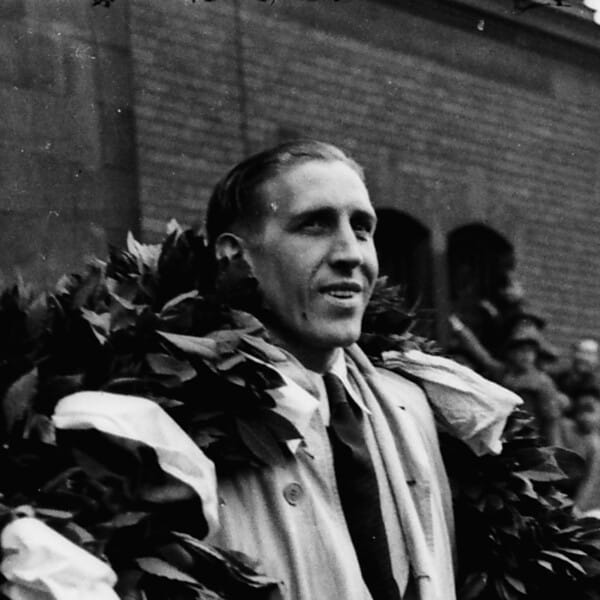
Ernst Kuzorra: Belonging and playing in Nazi Germany | Part 1
Very Simple Game #4 | Part I

Through the grainy monochrome of a minute-long footage from a match that happened more than ninety years ago, one can still see a robust footballer dribbling past a nagging defender with confident ease. He enters the box, which came without a D-marking, and shoots the ball into the bottom corner of the far post with his left foot before holding his arms up in a cheerful celebration.
This goal, scored in June 1934, won Schalke 04 their first national title. In the championship deciding final match, FC Nuremberg, the team that was then the most successful in terms of national championship titles in Germany, were coming up against newly ascendant Schalke, who had been promoted to the local top-tier only in 1927, the very year Nuremberg claimed their 5th national title of the decade. But Schalke, despite being the lesser-fancied outfit at this point, were no pushovers.
The Nazi regime started to leave strong imprints on the organisation of football in Germany, the very year that the Nazis came to obtain absolute power. From 1933 onwards, German football was divided into what can today be understood as a locally organised set of top-flight leagues. There were 16 local groupings, and the champions from each group advanced to a smaller tournament to determine the national champion.
Ernst Kuzorra: Belonging and playing in Nazi Germany
The first season under this new structure, the 1933/34 season, was also Schalke 04’s first notably successful season. The Nazi regime had a close, if incoherent, relationship with Schalke. In the regional Gauliga Westfalen, Schalke had won 16 out of 18 matches and lost only once. They had reached the final of the national championship in the preceding season, too. But Schalke were soundly defeated by Fortuna Düsseldorf. In the final against Nuremberg a year later, it felt like Schalke would have to be content with a consecutive second-place finish.
Georg Friedel had broken the deadlock for Nuremberg within the first ten minutes of the second half. Up until the 88th minute, Schalke were trailing one goal to nil. But then they drew level through an inspired Szepan, a wonderfully creative footballer who was one of the most prominent propagators of Schalke’s unconventional tactical approach. Only a couple of minutes in came the dramatic climax – right around the 90th-minute mark, Schalke had scored the decisive goal, one that we have already discussed. The goal-scorer was Ernst Kuzorra, considered one of the most prolific and iconic forwards in Schalke history.
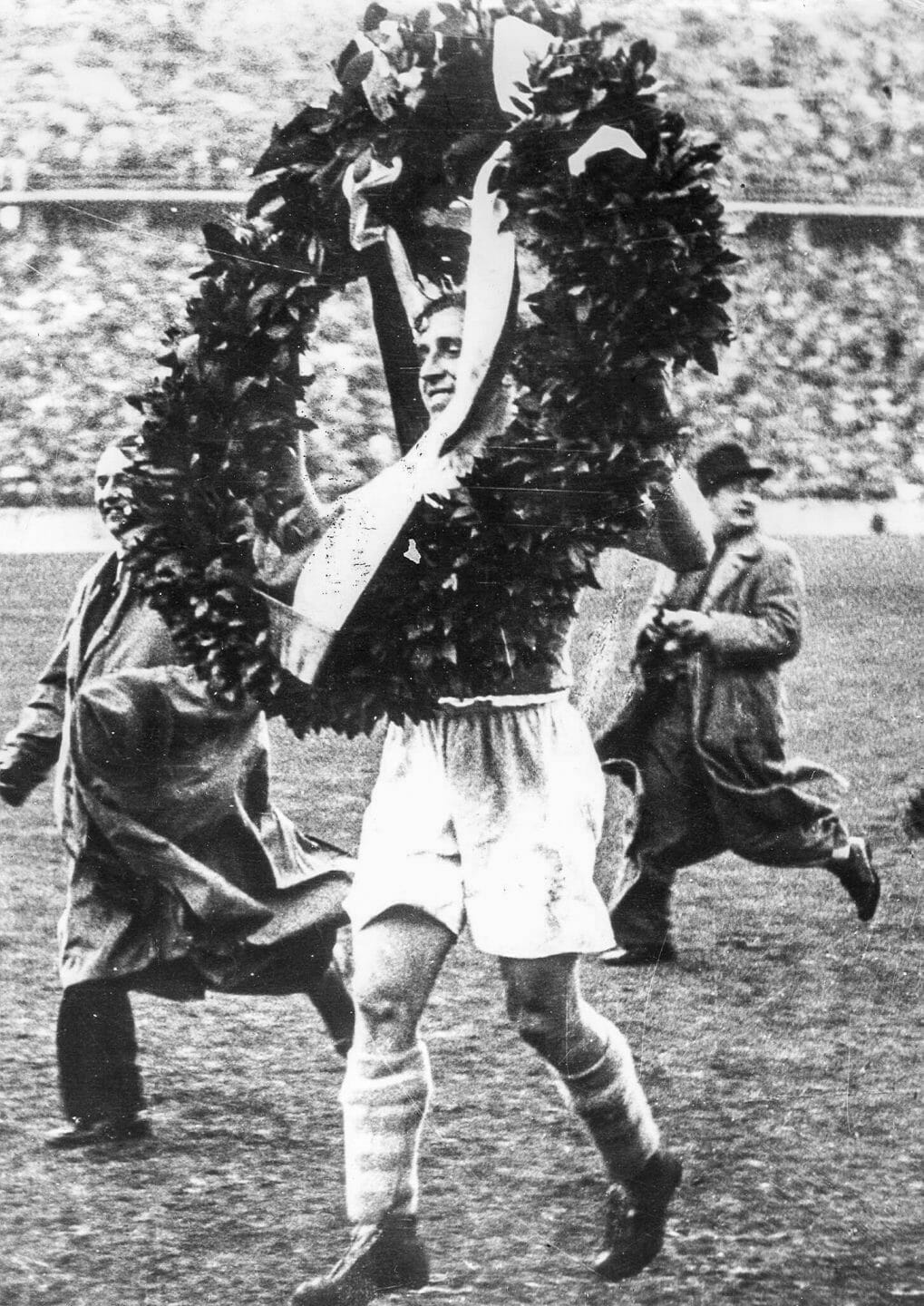
Football in pre-World War II Germany was not a formally professional pursuit. While loopholes in the rules have always been keenly exploited by clubs seeking to retain their strongest talents, these breaches were often harshly penalised to ensure compliance. Such practices were framed as antithetical to the bourgeois morale that sports were often made to represent.
Therefore, such extra-legal professionalism has frequently been associated with actors outside the bourgeois class. Highly industrialised locations were regarded as dens of rampant amateurism. The Ruhr region has had a complex place in the conception of the German national self. Schalke 04 was a representative institution of the Ruhr region from the early 1930s.
Playing as a striker for Schalke, Ernst Kuzorra is regarded as one of the first football stars to have hailed from the Ruhr region. Schalke was penalised with a ban in 1931 for breaching professionalism laws. Kuzorra was one of those players who found it difficult to return to the national team after this. Even though that was more likely the result of sharp differences (because Kuzorra used to be quite blunt in expressing his opinions that were not especially popular in Germany at the time) with national team manager Otto Nerz, who was also a dedicated member of the Nazi paramilitary force.
Kuzorra’s social position in the inter-war German social hierarchy is a fascinating topic for rumination. He was a child of one of the thousands of Masurian migrant families that had migrated to the Ruhr region in the early years of the twentieth century. The Ruhr was a hotspot of in-migration from the east as more and more people wanted to swap their rural occupations for work in the mining industry. Kuzorra grew up near a colliery and took up work as an unskilled labourer in the coal industry while his father was a miner.
Despite the heterogeneous roots of migrant groups, the migrant population of the Ruhr were stereotyped in the mainstream of German thought as “Polacks”, a pejorative slang for Polish immigrants. They were considered rowdy, quarrelsome, unsophisticated and heavy drinkers. This stereotyping was sharpened by the prevalence of Polish-sounding accents among the migrants from the east who spoke a multitude of different languages. None of Kuzorra’s parents could speak German.
Curiously, though, especially for Masurians, this position as the outsider, an ‘other’ for the rest of Germany, was not quite simple. Many Masurians considered themselves to have Prussian roots. They were Protestants and differentiated themselves from Catholic Poles. Despite facing prejudice from the proponents of German nationalism, they often staunchly held German nationalist views. These complicating factors that mark a migrant population in times of stark political polarisation were present in various ambiguities that marked Kuzorra’s life.
It was a wealthy Jewish businessman who helped Kuzorra obtain a driver’s license and nominally employed him as a driver, so he could focus on football by quitting his job at the coal mine. Kuzorra is known to have regularly bought football match tickets for Jewish youngsters when Jews were barred from entry into sports arenas in Germany. Yet, he volunteered to be a member of the Nazi party and also served in the Luftwaffe as a sergeant.
Ernst Kuzorra’s story reminds us of a very important fact that we often overlook: even in a society going through wanton violence and discrimination, the lines remain way blurrier than we like them to be. Kuzorra was neither a model hero nor a model villain. He was a fantastic footballer who, in many ways, embodies the varied possibilities that mark the moral grey zone between a perpetrator and a victim.
Read more – An All Time Real Madrid Best XI With No Two Players from a Country
Also see – De Zerbi Frustrated as Spurs Draw Leaves Survival in Balance
Follow Footy Times on Social Media:
Facebook | Instagram | Twitter | YouTube
Discover more from Footy Times
Subscribe to get the latest posts sent to your email.