

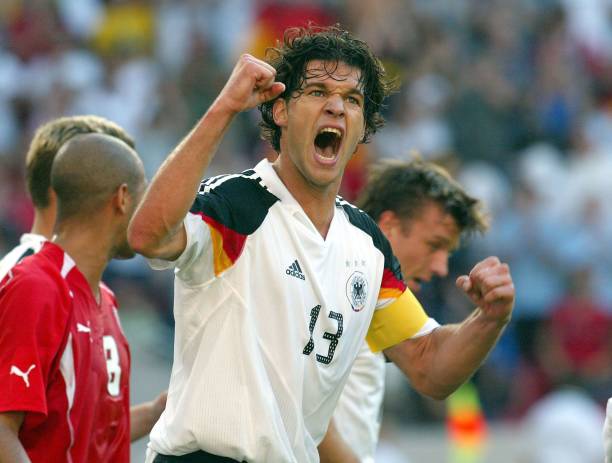

There is a photograph from the night of 25 June 2002 that captures something essential about Michael Ballack. He is sitting in the locker room at Seoul World Cup Stadium, still in his Germany kit, and he is weeping. His team had just beaten South Korea 1–0 to reach the World Cup final. He had scored the only goal. He had also picked up a yellow card — his second of the knockout stage — that would rule him out of that final. The man who had single-handedly dragged Germany to Yokohama could not play there.
That image is not a footnote to Ballack’s career. It is the defining text.
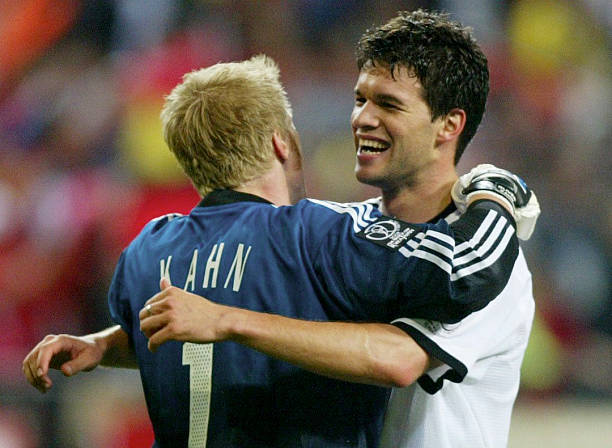
Few players in the modern era carried an international team so completely, or were denied so repeatedly by the architecture of the sport itself. To understand Ballack is to understand the strange cruelty that can attend greatness — and to understand a German football team that, for much of the 2000s, was essentially one man in a white shirt surrounded by mortals.
The Boy from the GDR
Ballack was born on 26 September 1976 in Görlitz, in the German Democratic Republic. That detail matters more than it might appear. He came of age in a country that ceased to exist while he was still a teenager, in a sporting culture that placed enormous weight on collective discipline and physical rigour. Those values never left him. He was not the dazzling flair player the continent was producing in abundance during the 1990s. He was something rarer and harder to quantify: a midfielder who made the game feel inevitable.
In 1999 he joined Bayer Leverkusen, where he broke through to become one of the elite players in Germany. What followed at Leverkusen was simultaneously a high-water mark and an augury of things to come. Leverkusen had a run for all three trophies — the Champions League, the German Cup and the league title — but would finish runners-up in all three competitions. German football still calls it the Neverkusen season. Ballack won the German Footballer of the Year award and left for Bayern Munich with a cupboard full of silver medals.
Yokohama, Without Him
By 2002, Ballack had become the gravitational centre of the German national team. Under Rudi Völler, a side of limited resources and diminishing European prestige found itself improbably deep into a World Cup in Japan and South Korea. The vehicle was Ballack.
He scored consecutive game-winning goals in the quarter-final and semi-final to help his country to the 2002 World Cup final. Against the United States in the last eight, he scored the winner with a powerful header in the 39th minute. Four days later, against South Korea in Seoul, his goal — off a rebound of his own shot — sent 64,000 home supporters into silence and put Germany into a final against Brazil.
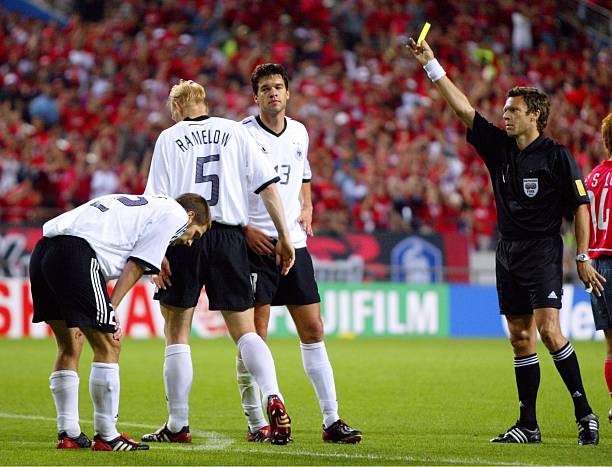
But four minutes before he scored, he had pulled down Lee Chun-soo just outside the penalty area. The yellow card was correctly given. “My first thoughts are bitterness,” Ballack said. “My dream was to play in the final, but now that will not be.” He cried in the locker room after the game.
Germany lost that final 2–0 to a Brazilian side carrying Ronaldo at his most unstoppable. Whether Ballack would have changed that outcome is the kind of question that keeps football fans awake. What is beyond question is that the player who had made the final possible was the only one not permitted to contest it.
The Captain’s Tournament
The 2006 World Cup was, in a different register, both Ballack’s finest hour and his bitterest near-miss. Germany were hosts. Named captain of the German national team in 2004, Ballack carried that armband into a tournament the whole country had spent years dreading and then, unexpectedly, adoring.
Under Jürgen Klinsmann, this was a younger, more adventurous Germany — Klose, Podolski, Schweinsteiger beginning to emerge. But almost everything still went through the feet of the imperious Ballack. He was the orchestrator, the presiding intelligence, the player opponents had to stop if they were to stop Germany.
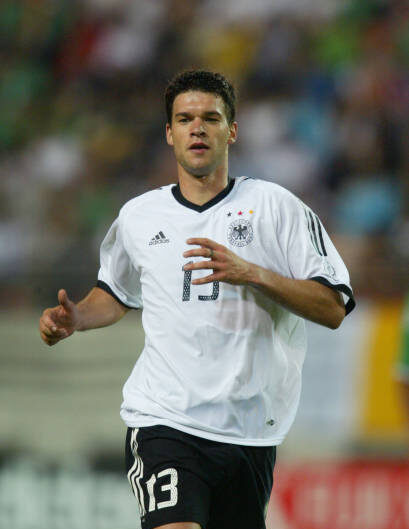
They made the semi-finals. There, in Dortmund, they met Italy. It remains one of the finest World Cup matches of the century. The match stayed goalless through the first 118 minutes; not from a lack of ambition but from an abundance of it on both sides. Then, in the 119th minute, Fabio Grosso curled a shot into the corner. Alessandro Del Piero added a second in the final seconds of extra time. Germany were out.
One of the oddest aspects of the 2006 World Cup was the German public’s response to their semi-final exit. They celebrated anyway — the streets, the fan zones, the euphoria of a nation that had rediscovered its relationship with football. But Ballack had come so close again to the prize that defined the century. Third place against Portugal offered little consolation.
The End That Never Came
What Ballack deserved, and never received, was a clean ending. As it transpired, the likes of Bastian Schweinsteiger stepped up to mark the dawn of a new era for the national team, eventually taking over the captain’s armband, a process that was accelerating even before the 2010 World Cup removed Ballack from the picture entirely.
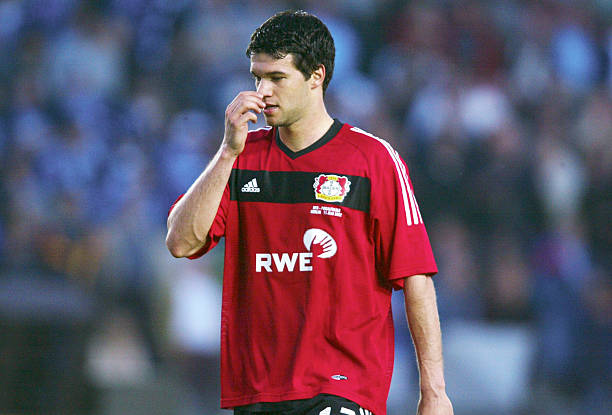
The circumstances of his final exclusion from international football remain among the more grimly poetic of the era. A broken leg resulting from a brutal challenge from Kevin-Prince Boateng in the 2010 FA Cup final kept him out of the 2010 World Cup squad and eventually led to him disappearing off the radar without as much as a loud blip. The young Germany that played in africa/”>South Africa — dynamic, fearless, carrying none of the stiffness of the previous decade — was everything his generation had pointed toward. He watched it from a hospital ward.
Michael Ballack concluded his Germany career in 2010 with 98 caps and 42 goals. He never won a World Cup. He never played in one’s final. The closest he came — Seoul, 2002 — ended with him in tears in a locker room, holding a yellow card like a death sentence.
What He Meant
Ballack’s misfortune at World Cups has made him vulnerable to a particular kind of narrative reduction: the nearly-man, the unlucky, the tragic figure. That framing is too small. The greater truth is that he kept Germany competitive during a period — roughly 2000 to 2006 — when the squad around him did not justify the results it produced. He was not a cog in a machine. He was, for long stretches, the machine.
He lost the 2006 World Cup semi-final, two Champions League finals, a European Championship final — a catalogue of defeats that, arranged in sequence, can look like evidence of some cosmic disposition against him. But they can equally be read as evidence of how often he was there, in the final exchanges of the most important matches, competing at the highest level.
The generation that followed him — Schweinsteiger, Özil, Müller — won the World Cup in 2014 playing a style of football that Ballack’s era had been groping toward. He helped build the foundation they stood on without ever standing on it himself. There is something distinctly humanistic about that: the figure who clears the path and does not take it, the leader whose legacy is written in other people’s trophies.
The armband, they say, reveals character. Ballack wore it as if he’d been born to it — and bore its weight long after the rewards ran out.
Read more – 2026 World Cup: The 16 Cities hosting the tournament
Also see – 2026 FIFA World Cup: Every Squad in Full
Follow Footy Times on Social Media:
Facebook | Instagram | Twitter | YouTube
Discover more from Footy Times
Subscribe to get the latest posts sent to your email.