
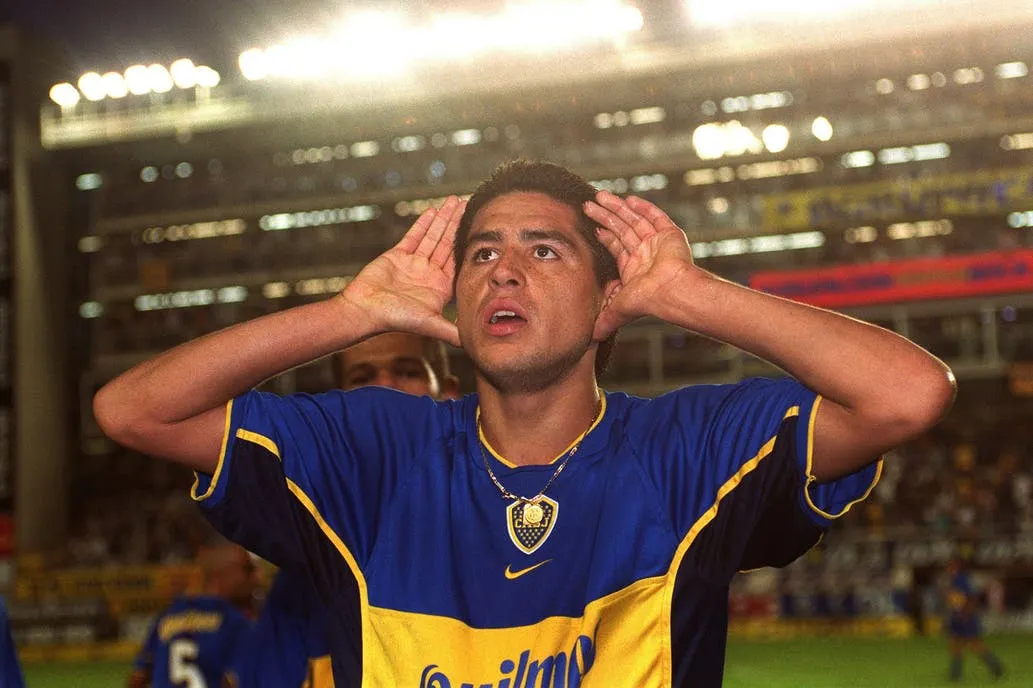

There is a moment in the 2006 World Cup quarter-final against Germany, in the 71st minute at the Olympic Stadium in Berlin, that tells you everything about Juan Román Riquelme and nothing about football’s wisdom. Argentina lead 1-0. The match is theirs to close. Riquelme, the architect of everything, the man who has run the tournament’s most beautiful attacking team from the centre of the pitch with something approaching papal authority, walks toward the touchline.
He is being substituted. Coach José Pékerman has decided to secure the lead with a defensive midfielder. Eight minutes later, Miroslav Klose equalises. Argentina’s shape dissolves without its centre. They lose on penalties, and the greatest playmaker of his generation walks out of the only World Cup he will ever play in, replaced not by a goal or an injury or old age, but by a decision that football has never quite forgiven. That substitution is not the story of Riquelme, but it is the door through which you enter it.
The Enganche from San Fernando
Riquelme was born in a poor, shadowed shanty town the day before Argentina won the 1978 World Cup. That proximity to glory, born on the eve of it and never quite reaching it himself, feels less like biography and more like a structuring metaphor for everything that followed. He grew up in Don Torcuato, in Greater Buenos Aires, discovering at the age of ten that his father was a local gang member.
Football was both an escape and a vocation. By sixteen, he was in the Boca Juniors academy, learning the position that would define him: the enganche, the hook, the classic Argentine number 10 who drops deep, receives the ball with his back to goal, turns, and opens the world.
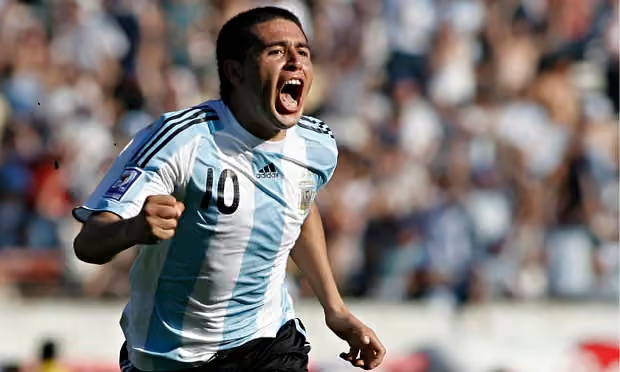
Argentina has a long, largely joyful and sometimes torturous relationship with the number 10, a role which has deep cultural significance. The public expects. For the national team, Diego Maradona was the archetype, followed by pretenders to the crown such as Marcelo Gallardo, Ariel Ortega, Andres D’Alessandro and Pablo Aimar. Each carried the weight of the comparison and eventually buckled under it. Riquelme, uniquely, did not attempt to be Maradona.
He was something different: slower, more cerebral, more patient. Where Maradona detonated, Riquelme conducted. Unlike Maradona, who was often praised for his lightning-fast play, Riquelme was known for slowing the game to his own pace and taking advantage of any opportunity. In an era that was beginning to demand the relentless pressing and vertical intensity that would eventually remake European football entirely, this was either genius or obstinacy, depending on your temperament.
A Stage Too Small and Too Large
Riquelme’s international career is bookended by absences that illuminate his character. He missed the 2002 World Cup because “his head wasn’t right” following the kidnap of his brother. When Argentina needed him most in Japan and Korea, he was elsewhere in every sense, dealing with a family crisis that the football calendar cared nothing about. That withdrawal was never fully explained in public and never needed to be. It told you that Riquelme operated on a different register of priority than most professional footballers.
By 2006 he had remade himself at Villarreal, turning a modest Spanish club into a European force of genuine ambition and helping them reach the Champions League semi-finals in 2006, a run that brought him his most sustained exposure to elite European football. He arrived at the World Cup in Germany at the peak of his creative powers. He topped the 2006 World Cup charts for assists with four.
With two assists in the first three group games, regularly pulling the strings between the lines, Riquelme was at his best. He won the Man of the Match award in the second group game against Serbia and Montenegro. This was Argentina as they had not appeared in years: fluid, technically assured, a side built around the complete authority of one man. Riquelme was arguably the world’s best playmaker going into the tournament, and proved instrumental in Argentina’s surge to the quarter-finals. He was not merely a luxury, the charge that had always followed him. He was the engine.
Berlin, 72nd Minute
The Germany quarter-final remains one of the most contested coaching decisions in World Cup history. Argentina led through a Roberto Ayala header from a Riquelme corner. Riquelme’s influence was declining and Pékerman elected to take him off, although a couple of later injuries then meant that he was unable to introduce the teenage Lionel Messi. The substitution was not entirely without logic. Riquelme hadn’t been his dominant self, so taking him off was by no means nonsensical, but replacing him with efficient enforcer Esteban Cambiasso rather than the infinitely more inventive Lionel Messi or Pablo Aimar was negative to the point of being suicidal. A second goal would have killed Germany; instead, Argentina began to cower.
Swedish journalists wrote that Pékerman made a big error by trying to close the game at 1,0, noting that he should have brought on Messi and tried to get another goal, because the Germans are never beaten. They added that perhaps the bigger error was taking off Riquelme, as his playmaker was gone and the pattern of the team was lost. Germany equalised. The shootout followed. Argentina were out. And Riquelme, watching from the substitutes’ bench with 20 minutes still to play, experienced the particular torture reserved for players of his type, the creative intelligence rendered helpless, the game proceeding without its author.
It would be his last World Cup appearance. He fell out with Diego Maradona after the latter was appointed national team coach in 2008 and refused to work under him. Riquelme stated that they did not agree on much, they did not have the same principles, and as long as Maradona was coach of the team, they could not work together, declining even to speak Maradona’s name in public. The heir had rejected the king. He retired from international football in March 2009, with 51 appearances and 17 goals for Argentina.
The Slowness Was the Point
Football has always been ambivalent about intelligence that does not translate into pace. Riquelme’s career was punctuated by coaches who loved him and those who found him impossible, who saw a player who walked when others sprinted, who held the ball when modern doctrine demanded its immediate release, who seemed to conduct the game rather than participate in it.
Arguably the purest example of the number 10, his languid style and silken touch enraptured at times and infuriated at others. A master of space and angles, unlocking tightly-packed defences and toying with the opposition, in many ways he was a player strangely out of step with modern football. But that framing misses the point. His slowness was not a limitation.
It was a philosophical position. He understood that the ball moves faster than any player can run, and that the art of the playmaker is not athleticism but anticipation, not covering ground but dictating where ground is covered. César Luis Menotti, the Argentine football philosopher, said of him that he thought the game more than he played it, which is why he was a genius.
After the Whistle
Riquelme returned to Boca Juniors in 2007, playing out his best years where he had always belonged, in the cathedral of La Bombonera, in front of supporters who understood that watching him was not like watching other footballers. He piled up five Argentine titles, three Copa Libertadores trophies, and an Intercontinental Cup triumph over Real Madrid in 2000. He retired in January 2015 and was elected President of Boca Juniors in December 2023. He left behind no dance moves, no flashy social media presence, no empire of endorsements. Just memories. Perfect passes. Silences that spoke more than screams.
The generation that came after him, built on gegenpressing, high lines and positional intensity, plays nothing like he did. Which is precisely why he endures as a reference point rather than a model: a reminder that football once had room for a man who made opponents chase shadows and crowds hold their breath, a man who treated every pass as a statement of intent. The World Cup never gave him what he deserved. But those four assists in Germany in 2006, and the ghost of a 72nd-minute substitution that still haunts Argentine football, are monument enough.
Read more – African Referee Omar Abdulkadir Artan Denied Entry to US for 2026 FIFA World Cup
Also see – Michael Ballack: Germany’s Glorious Nearly-Man
Follow Footy Times on Social Media:
Facebook | Instagram | Twitter | YouTube
Discover more from Footy Times
Subscribe to get the latest posts sent to your email.