

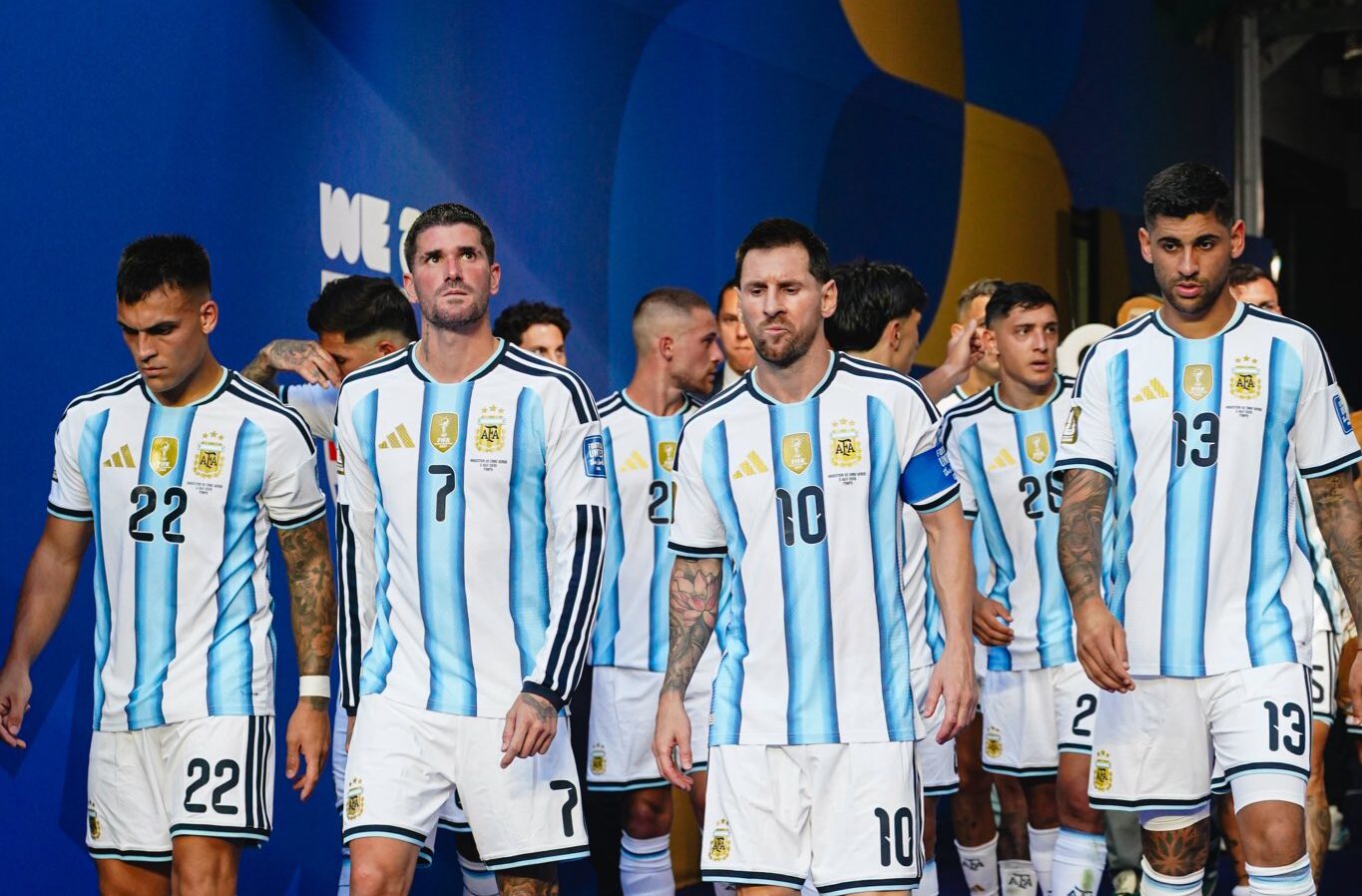

When Egypt fans held Palestinian flags inside the Atlanta stadium during their World Cup match against Argentina last week, and Argentine supporters raised an Israeli flag in response, the football pitch became — as it has increasingly been becoming — a site where the most consequential geopolitical conflict of our time was being contested by proxy. The football was extraordinary. Egypt led 2-0 with eleven minutes remaining before Argentina scored three times to win 3-2 in stoppage time, Messi’s 84th-minute equaliser the pivot on which the entire match turned. The context around it was unavoidable. And at the centre of the controversy, as he has been for over a decade, was the man whose late equaliser completed Argentina’s remarkable comeback: Lionel Messi.
Social media in the aftermath was flooded with familiar claims. Messi is a Zionist. Messi supports Israel’s genocide in Gaza. He donated money to Israel. Edited images circulated of him holding an Israeli flag. These specific claims are false. Reuters, AFP and multiple independent fact-checking organisations have debunked them individually and repeatedly. There is no verified evidence that Messi has publicly declared support for Israel in the current conflict, endorsed Zionism as a political position, or donated money to Israel. The doctored images are fabrications.
But dismissing the misinformation does not dismiss the underlying questions. The documented record of Messi’s relationship with Israel is real, consequential, and more complicated than either the most aggressive critics or the most defensive defenders have been willing to acknowledge.
What Actually Happened
In August 2013, FC Barcelona made a two-day “peace tour” of Israel and the Palestinian territories, with Messi among the squad. The visit was organised by the Peres Centre for Peace alongside both the Israeli and Palestinian football federations. It included football clinics for Israeli and Palestinian children jointly. Barcelona visited the Palestinian territories — Messi met Palestinian President Mahmoud Abbas in Bethlehem. They also met Israeli President Shimon Peres and Prime Minister Benjamin Netanyahu on the Israeli side. Messi visited the Western Wall in Jerusalem and left a prayer note. Jibril Rajoub, then president of the Palestinian Football Federation, called it “an historic day” and said “sport is the best way to overcome hate and hostility.” The visit was explicitly bilateral.
Whether the “peace tour” framing itself was politically naive, instrumentally useful for Israeli diplomacy, or genuinely reconciliatory is a legitimate debate. East Jerusalem’s political status is contested; visiting the Western Wall carries geopolitical implications regardless of personal intention. Critics who argue that any engagement with Israeli institutions in occupied territory normalises the occupation are making a coherent argument. What the facts do not support is the claim that Messi made a unilateral, pro-Israel political gesture — the Palestinian federation welcomed the visit, met the players, and co-organised it.
In 2014, during Israel’s military operation in Gaza, Messi posted on Facebook: “As a father and a UNICEF Goodwill Ambassador, I am terribly saddened by the images coming from the conflict between Israel and Palestine, where violence has already claimed so many young lives and injured countless children. Children did not create this conflict, but they are paying the ultimate price.” The statement expressed concern for Palestinian children. It did not take a political position on responsibility or Israeli policy. For critics it was insufficient. For defenders it was evidence of concern. What it was not was pro-Israel.
The 2018 planned friendly between Argentina and Israel in Jerusalem — not Tel Aviv but Jerusalem, the city whose status as Israel’s capital is contested internationally — became a flashpoint. Palestinian groups mounted an intense campaign for cancellation, arguing that the venue choice effectively endorsed Israeli sovereignty over occupied East Jerusalem. The match was cancelled amid protests and security concerns. Neither Messi nor the Argentine Football Association publicly attributed the cancellation to political sympathy with Palestine. The Palestinian football federation, which had been calling for cancellation, paid a price for its advocacy: FIFA disciplined Rajoub for his public pressure campaign. Palestinian advocacy cost their federation, not the Israeli side that had chosen the contested venue.
In November 2019, Argentina played a friendly against Uruguay in Tel Aviv at Bloomfield Stadium, attended by roughly 30,000 spectators. The match was funded by Sylvan Adams, a Canadian-Israeli billionaire, and Israeli officials explicitly described it as a public diplomacy victory — an opportunity to showcase Israel to the world through football. Messi scored a late penalty in a 2-2 draw. He made no public statement about the match’s political context.
The Silence That Has Become the Story
Since October 2023, the Israeli military campaign in Gaza has killed tens of thousands of Palestinians, a toll that has generated unprecedented international condemnation and an ongoing case at the International Court of Justice. Palestinian athletes and footballers have been killed in significant numbers during the conflict. Messi has said nothing about any of this. For nearly two years, as football figures around the world have expressed opinions ranging from carefully worded concern to explicit condemnation, the world’s most followed athlete — a UNICEF Goodwill Ambassador with 500 million social media followers — has maintained complete public silence.
Silence is not a statement of support. But in this specific context — given his previous visits to Israel, the 2019 match’s explicit use as Israeli public diplomacy, and his global platform — his silence has been experienced by Palestinian communities and their supporters as a form of complicity. That experience is understandable even if the moral category of “complicity by silence” is contested. The Palestinian writer and academic Edward Said argued that the refusal to speak, for those with the means to do so safely, is itself a political act. Whether one applies that framework to Messi’s silence is a matter of individual judgement. That the silence is conspicuous is not.
The Political Frame Around Him
The controversy around Messi cannot be separated from the political context that surrounds the Argentina team. President Javier Milei has proclaimed himself “proud to be the most Zionist president in the world.” He is close to Donald Trump, who has called him “my favourite president” and who has extended explicit American support to Israel throughout the current conflict. Trump and FIFA president Gianni Infantino — whose closeness has been widely noted, including when Trump publicly said he called Infantino to request that Folarin Balogun’s red card be reversed, a call Infantino acted on — have a relationship whose implications for the governance of this tournament have been openly questioned.
None of this makes Messi responsible for Milei’s politics. Athletes are not accountable for the political positions of their governments. But the frame it creates — in which Argentina plays under a president who explicitly aligns himself with Zionism, in a tournament whose governing body has maintained close relationships with Israeli-aligned political figures — inevitably shapes how Messi is perceived in communities for whom Palestine is not a political abstraction but a present emergency.
The atmosphere in Atlanta confirmed this. Egyptian manager Hossam Hassan had waved the Palestinian flag after Egypt’s Round of 32 victory over Australia and dedicated the win to Palestine in his post-match press conference. He used the pre-match press conference to deliver what he described as a passionate address about Palestinian suffering, saying that anyone who does not feel compassion for Palestinians “is not a human being.” Inside the stadium during the match itself, Palestinian and Israeli flags appeared in opposing sets of supporters. The match had become, as Al Jazeera’s Mohamad Elmasry put it, “the latest marker of the Palestinian struggle.”
What the Debate Is Actually About
The “Messi is a Zionist” claim, stripped of its misinformation, reduces to a set of genuine and serious questions that go beyond any individual player. What do athletes with massive global platforms owe in the context of a crisis of this scale? Does visiting a country constitute political endorsement of its government? Does silence, for someone with Messi’s reach, function as neutrality or as acquiescence? Is the “peace tour” framing of the 2013 visit a genuine model for sport diplomacy or a form of normalisation that treats an occupied population and the occupying power as symmetrical parties?
These are not questions with obvious answers. They are, however, questions that deserve to be engaged with honestly rather than resolved through fabricated images and attributed quotes.
There is a final irony worth naming. The online Messi-Ronaldo rivalry has produced, in the context of Palestine, a specific dynamic: sections of Ronaldo’s fanbase — particularly in Arab and Muslim communities where he enjoys enormous popularity — have projected him as a de facto champion of the Palestinian cause, deploying his supposed solidarity as a stick with which to beat Messi. The claims are overwhelmingly unverified. The alleged refusal to swap jerseys with Israeli players is not documented. The “golden boot donated to Gaza” narrative conflates a Real Madrid Foundation initiative with a personal political act. Multiple fact-checkers confirm that Ronaldo, like Messi, has made no public statement on either side of the current conflict. What is documented is rather different: in 2016, Ronaldo appeared in and publicly posted a promotional video for HOT, an Israeli internet company, drawing immediate Palestinian backlash. In early 2023, Israel’s own state broadcaster KAN News reported that the Israeli Foreign Ministry was actively considering using Ronaldo’s high-profile presence in Saudi Arabia as a normalisation tool — a report confirmed by Middle East Monitor. In October 2023, as Israel’s military operation in Gaza began, Ronaldo attended a boxing event in Saudi Arabia without public comment. None of this makes Ronaldo a Zionist any more than Messi’s visits make him one. What it does make is the selective application of scrutiny — Messi condemned, Ronaldo celebrated, on the basis of the same fundamental silence — a form of tribalism dressed as political conscience.
The documented record of Messi’s relationship with Israel does not make him a Zionist. It does make him a footballer who has visited Israel on multiple occasions, whose presence there has been used for purposes he has not publicly acknowledged or contested, who has been silent during a period when that silence has been conspicuous, and who plays for a country whose president openly champions the ideology his critics accuse him of holding.
That is complicated. It is also, unlike the misinformation that surrounds it, true.
Read more – Argentina Survive Swiss Scare to Set Up Blockbuster World Cup Semi-final Against England
Also see – Record Breaker, History Maker: There Is Simply Nobody Like Messi
Follow Footy Times on Social Media:
Facebook | Instagram | Twitter | YouTube
Discover more from Footy Times
Subscribe to get the latest posts sent to your email.